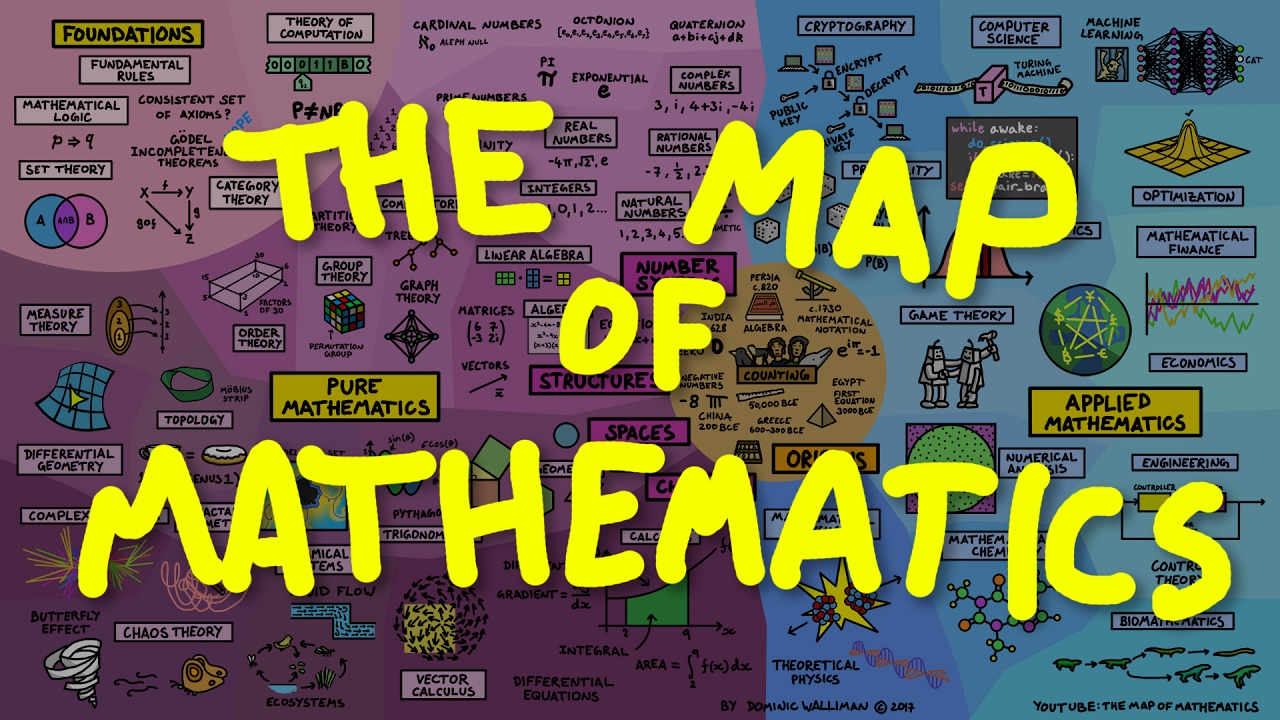
The Map of Mathematics
Physicist Dominic Walliman draws the entire field of mathematics as a single map, then walks through it region by region. He starts with the earliest human counting systems and the invention of zero and negative numbers, before splitting the map into two territories: pure mathematics, covering number theory, algebra, geometry, and topology, and applied mathematics, covering probability, mathematical physics, and the tools behind engineering and computing. He traces how ideas move between the two sides, from complex numbers emerging out of impossible equations to trigonometry problems he flags and corrects afterward in his own errata. The map also marks the field's rougher edges, including a brief, later-retracted claim about what Gödel's Incompleteness Theorems mean for whether mathematics is invented or discovered. It's part of a series of subject maps Walliman has drawn for physics, chemistry, and computer science, and this one runs just over ten minutes as an orientation to where every branch of math sits relative to the others.