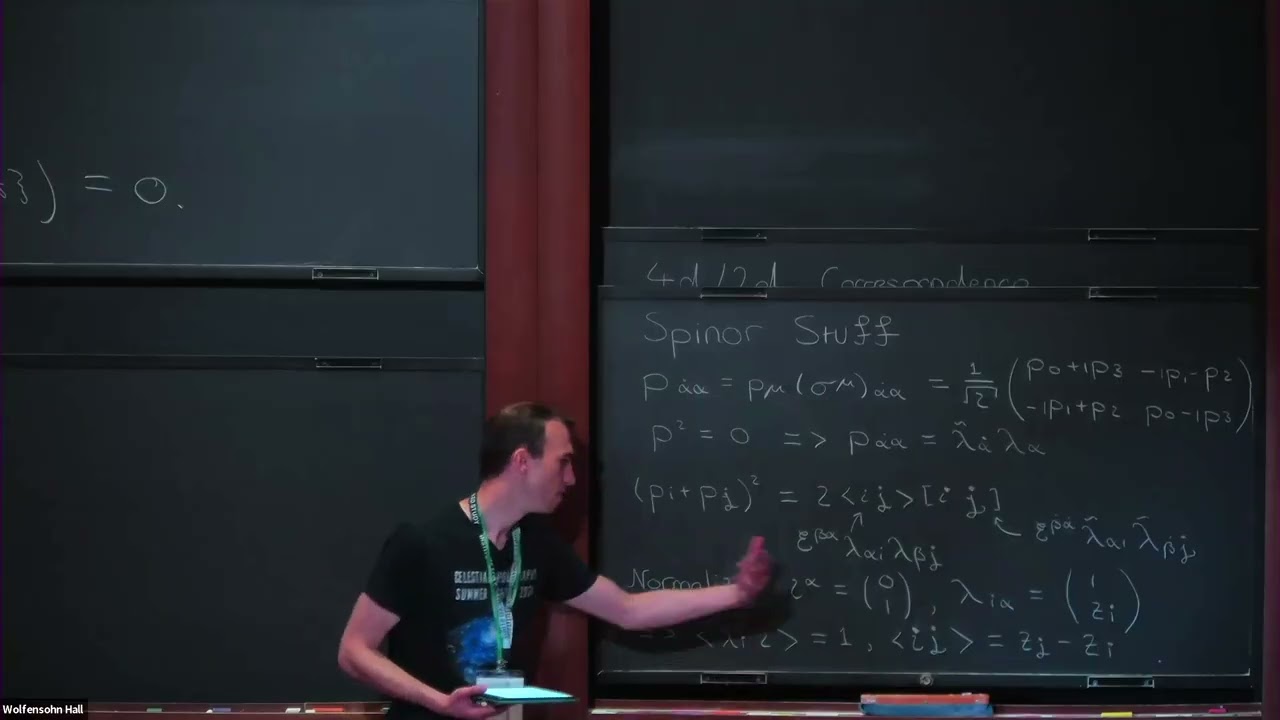
A Primer on Self Dual Theories - Part 2
Roland Bittleston of the Perimeter Institute for Theoretical Physics continues his introduction to self-dual field theories in this second installment from the Prospects in Theoretical Physics program. Building on the first lecture's setup, he works through the mathematical structure that makes self-dual Yang-Mills and self-dual gravity simpler than their full counterparts while still capturing key features of the parent theories, including their integrability properties and their role as toy models for scattering amplitude calculations. Bittleston develops the formalism on the board, tracing how constraints like self-duality reduce the degrees of freedom and connect to twistor-theoretic methods used elsewhere in theoretical physics. The talk is pitched at researchers and graduate students already familiar with gauge theory and general relativity, assuming the groundwork laid in part one. It runs just over an hour and functions as a working seminar rather than a polished public lecture, with the chalk-and-blackboard pace typical of Perimeter's advanced research talks.