Asymptotic Symmetries and Detectors - Part 1
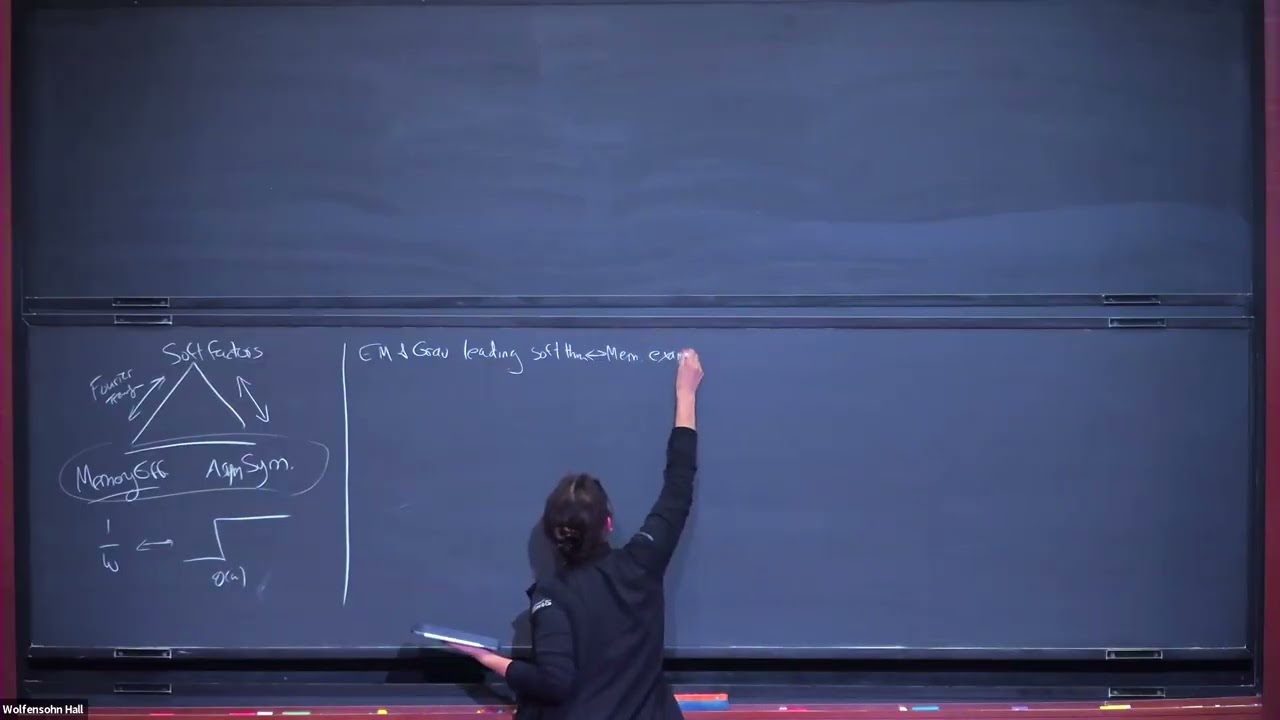
Sabrina Pasterski, speaking at the Institute for Advanced Study's Prospects in Theoretical Physics 2026 program, opens a two part lecture on asymptotic symmetries in gauge theory and gravity and how they connect to detector observables. Pasterski, known for her work on celestial holography, builds up the modern framework linking soft theorems, memory effects, and the symmetry structure of radiative phenomena at null infinity, the mathematical language used to describe what distant observers and detectors actually register from scattering processes. The talk is aimed at theoretical physicists already comfortable with quantum field theory and general relativity, working through the formalism that ties asymptotic symmetry groups to physically measurable quantities. As a first installment, it lays the conceptual and technical groundwork, covering the setup of asymptotic symmetry algebras and their relation to detector observables, before a second part presumably pushes further into applications. The delivery is blackboard style theoretical physics, dense with derivations rather than illustrations, aimed squarely at a research audience rather than general viewers.