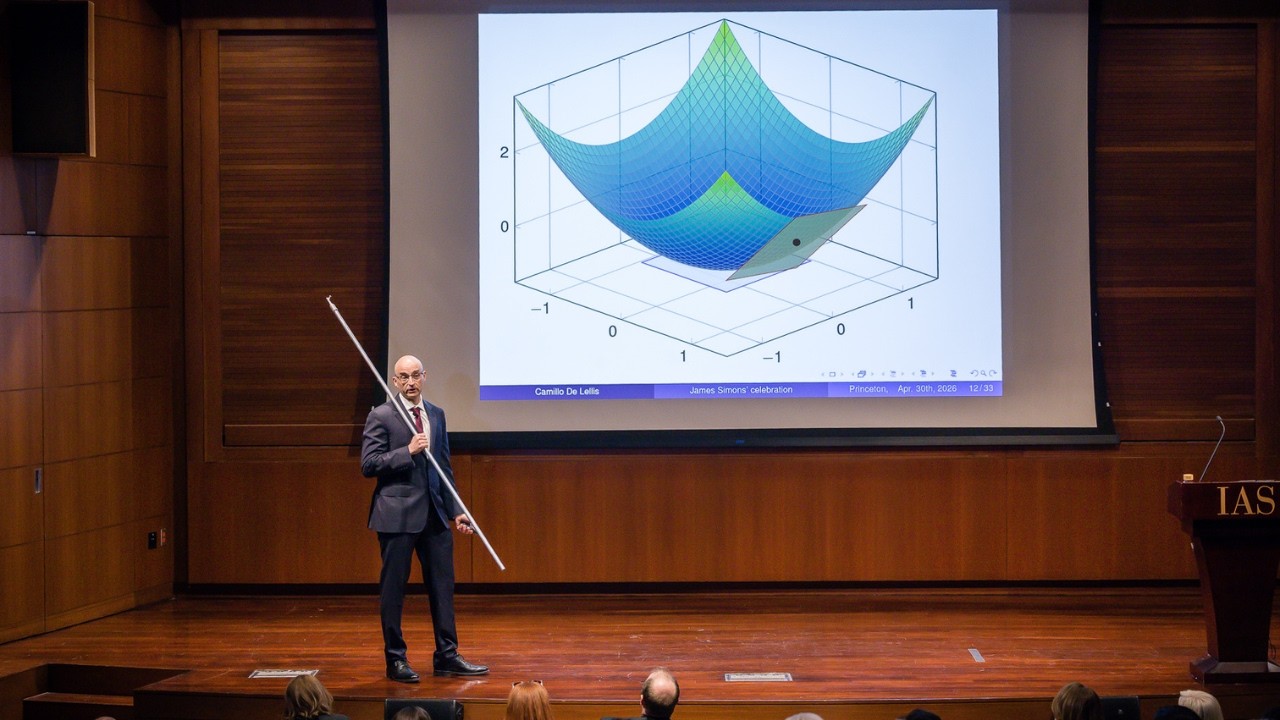
Breaking the Bubble: From the Brachistochrone to the Simons Cone
Camillo De Lellis, IBM von Neumann Professor at the Institute for Advanced Study, traces the calculus of variations from the seventeenth-century brachistochrone problem, the search for the fastest path for a falling object, through to modern minimal surface theory. Delivered in Wolfensohn Hall as a public lecture honoring Jim Simons, the talk connects soap-film geometry to Simons's 1968 paper Minimal Varieties in Riemannian Manifolds and his discovery of the Simons Cone, which showed that area-minimizing surfaces lose their smoothness in higher dimensions. De Lellis walks through how this result resolved a long-standing mystery about regularity in geometric analysis and reshaped the field. Introduced by Board Chair John A. Overdeck, the lecture balances historical narrative with the mathematical substance of Simons's work, aimed at a public audience but grounded in real technical detail about variational problems and higher-dimensional geometry.