Combinatorics and Geometry of Fundamental Physics and Cosmology
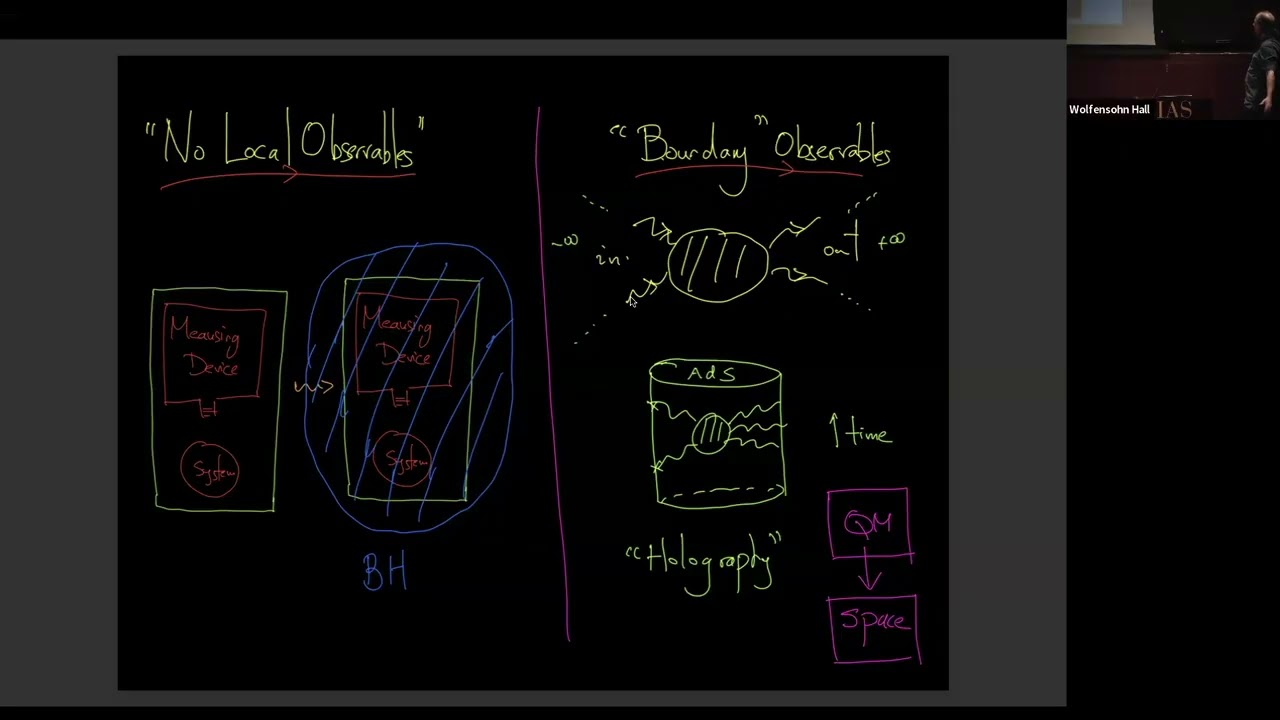
Theoretical physicist Nima Arkani-Hamed, of the Institute for Advanced Study, argues that the deepest patterns in particle physics and cosmology are showing up not in traditional equations but in combinatorial and geometric structures. Delivered at Wolfensohn Hall as part of the MPG-IAS-NTU Center kickoff conference, the talk traces how scattering amplitudes, long computed through sprawling Feynman diagrams, turn out to be governed by simpler positive geometries, objects whose volumes directly encode particle interactions. Arkani-Hamed extends this way of thinking toward cosmological observables, suggesting that the same combinatorial logic that simplifies collider physics might also organize the statistics of the early universe. He moves between blackboard-style derivations and broader claims about where fundamental physics is heading, treating geometry and combinatorics as a more honest language for nature than conventional Lagrangians. The talk assumes graduate-level familiarity with quantum field theory and offers a dense, idea-driven survey of a research program rather than a general-audience overview.