Decoding the Biographies of Binary Compact Objects Observed in Gravitational Waves
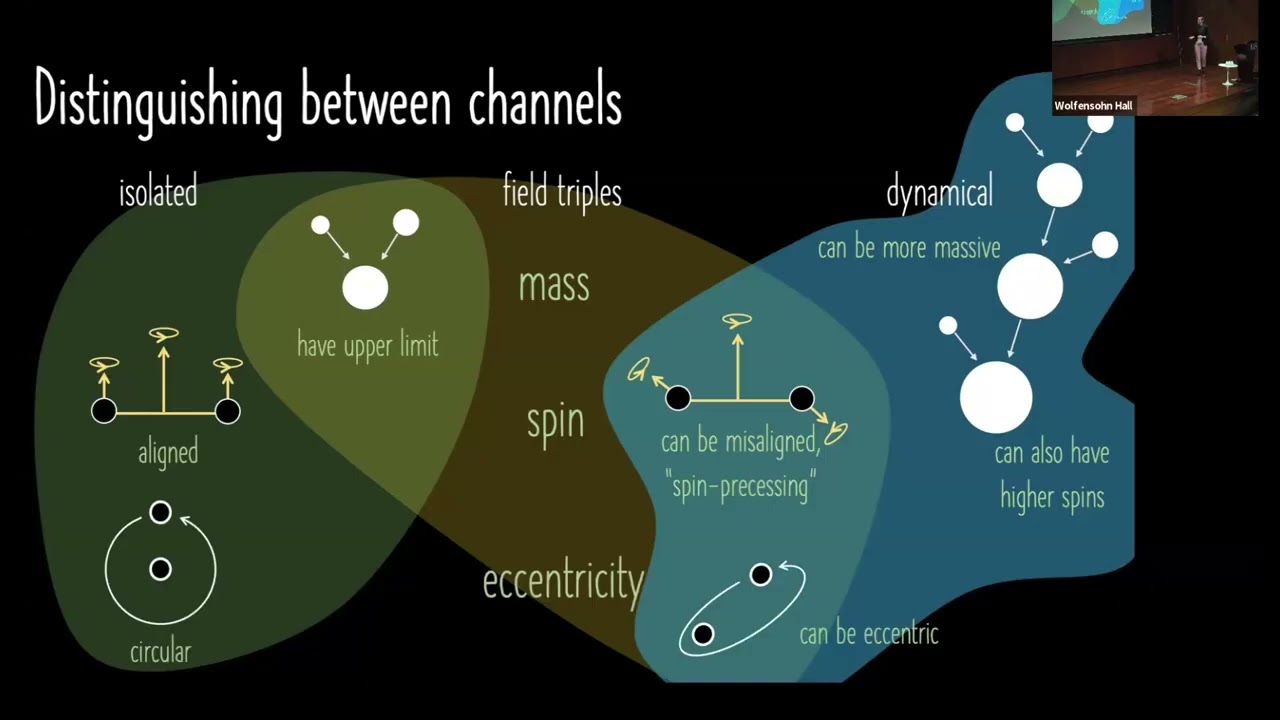
Isobel Romero-Shaw, an astrophysicist at Cardiff University, argues that the gravitational wave signals LIGO and Virgo detect from merging black holes and neutron stars carry more than just masses and spins, they encode clues about how each binary formed. Speaking at the MPG-IAS-NTU Center kick-off conference in Wolfensohn Hall, she walks through the competing formation channels proposed for these compact object pairs, isolated binary evolution versus dynamical assembly in dense star clusters, and explains which observable parameters, such as eccentricity and spin misalignment, can distinguish one channel from another. She discusses how statistical analysis across the growing catalog of detected mergers lets astronomers reconstruct a population-level history rather than treat each event in isolation. The talk is aimed at researchers already familiar with gravitational wave astronomy and situates her own work within the broader push to turn LIGO's catalog into a genuine astrophysical record of how compact binaries are born and evolve across cosmic time.