Expanders Meet Reed-Muller: Easy Instances of Noisy k-XOR
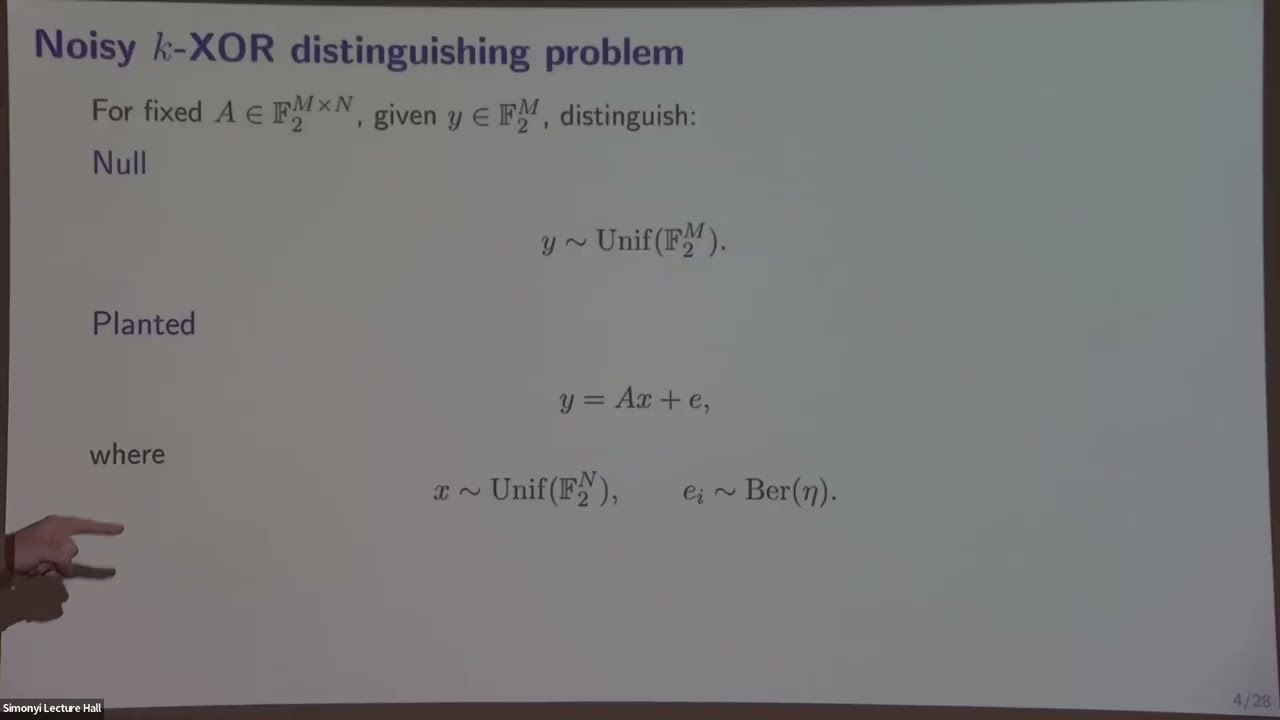
Jarosław Błasiok, of Bocconi University, presents this Institute for Advanced Study discrete mathematics seminar on the noisy k-XOR problem, a core question in computational complexity. The setup: given a vector y over the binary field, decide whether it is uniformly random or constructed from a bipartite constraint graph, a hidden assignment, and random noise. Błasiok explains why expansion properties of the underlying graph have been conjectured to force computational hardness, with evidence from Sum-of-Squares and low-degree polynomial lower bounds. He then shows the conjecture is false by building an explicit graph family with near-optimal expansion where the problem is solvable in polynomial time. The construction merges Guruswami-Umans-Vadhan lossless expanders with Reed-Muller code decoding, reframing the XOR problem as recovering a codeword from random errors. The talk is technical and aimed at specialists in pseudorandomness, coding theory, and complexity theory, working through the construction and its implications on the board.