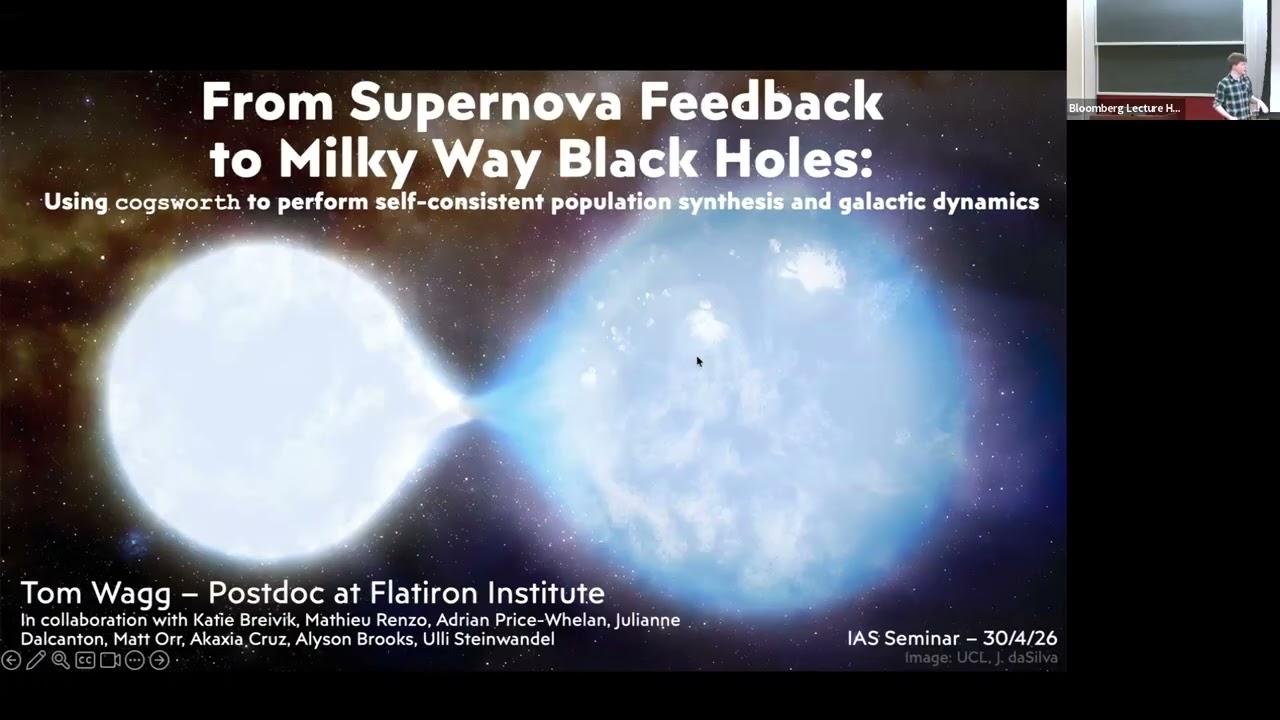
From Supernova Feedback to Milky Way Black Holes: Using Cogsworth to Perform Self-Consistent Population Synthesis with Galactic Dynamics
Tom Wagg of the Center for Computational Astrophysics at the Flatiron Institute presents cogsworth, a new code that combines binary stellar population synthesis with galactic dynamics, in this Institute for Advanced Study astrophysics seminar. He argues that most massive stars form in binaries, and that binary interactions eject these stars from their birth sites in ways that reshape where supernova feedback actually occurs in a galaxy. Wagg walks through how cogsworth models specific binary orbits and evolutionary paths, tracks present-day positions of subpopulations like runaway stars and X-ray binaries, and converts theoretical populations into observables comparable to Gaia data. He shows how delayed, displaced supernova feedback can suppress star formation near its source while triggering it elsewhere in the galaxy, and closes with preliminary work mapping the spatial distribution of black holes across the Milky Way and using microlensing to constrain binary evolution models. The talk is dense with technical detail aimed at working astrophysicists.