Glass Forming Theories
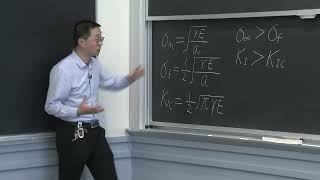
Juejun Hu continues MIT's 3.071 Amorphous Materials course with a lecture on why certain substances form glasses rather than crystallizing. He covers amorphous semiconductors and metallic glasses, comparing their bonding and structural behavior, and builds toward the role of topology in determining glass stability. The lecture works through theoretical frameworks for predicting glass-forming ability, connecting atomic-scale constraints and network rigidity to macroscopic material properties. Hu uses the blackboard and slides typical of MIT OpenCourseWare recordings, walking through the reasoning behind each model rather than just presenting conclusions. This is the third lecture on the course's third topic, aimed at students who already have background in the earlier sessions on amorphous structure, and it assumes familiarity with basic solid-state and materials science concepts. Eighty minutes of graduate-level materials science covering one of the field's central theoretical questions: what makes some materials resist crystallization.