Gravitational Waveform Modeling with Physics-Informed Neural Networks and Surrogates
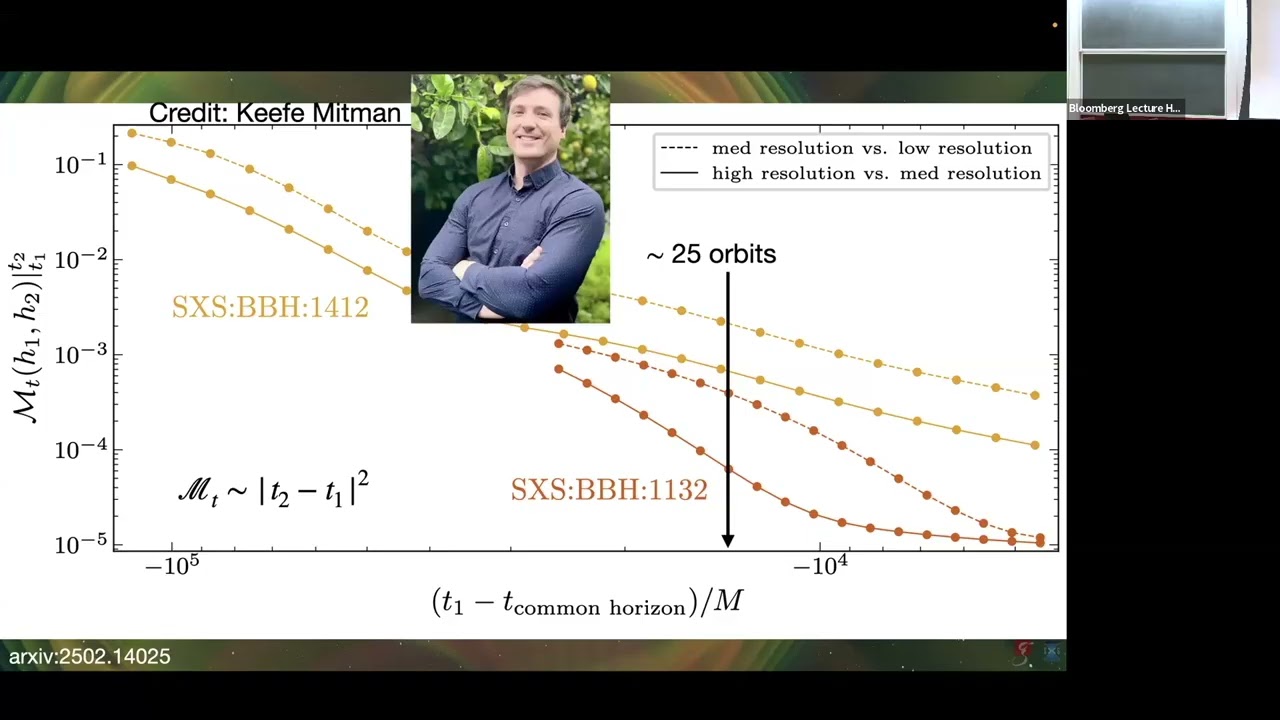
Nils Deppe, an astrophysicist at Cornell University, presents this Institute for Advanced Study astrophysics seminar on building faster models of gravitational waveforms, the signals detected by LIGO, Virgo, and KAGRA when black holes and neutron stars spiral together. He walks through a proof-of-concept model that augments post-Newtonian equations with techniques borrowed from physics-informed neural networks and universal differential equations, blending known physics with machine learning rather than replacing one with the other. The second half covers Deppe's ongoing work on a precessing surrogate model, one designed to evaluate in under a millisecond while covering more of the frequency band that ground-based detectors actually observe. The talk is aimed at researchers already working in gravitational wave astronomy, moving through the mathematical structure of the models and the computational tradeoffs behind building something fast enough for real-time parameter estimation. It runs just over an hour and stays close to the technical literature, including a specific arXiv paper discussed in detail.