Holograms and their Standard Models: DSSYK∞ and the 't Hooft Model
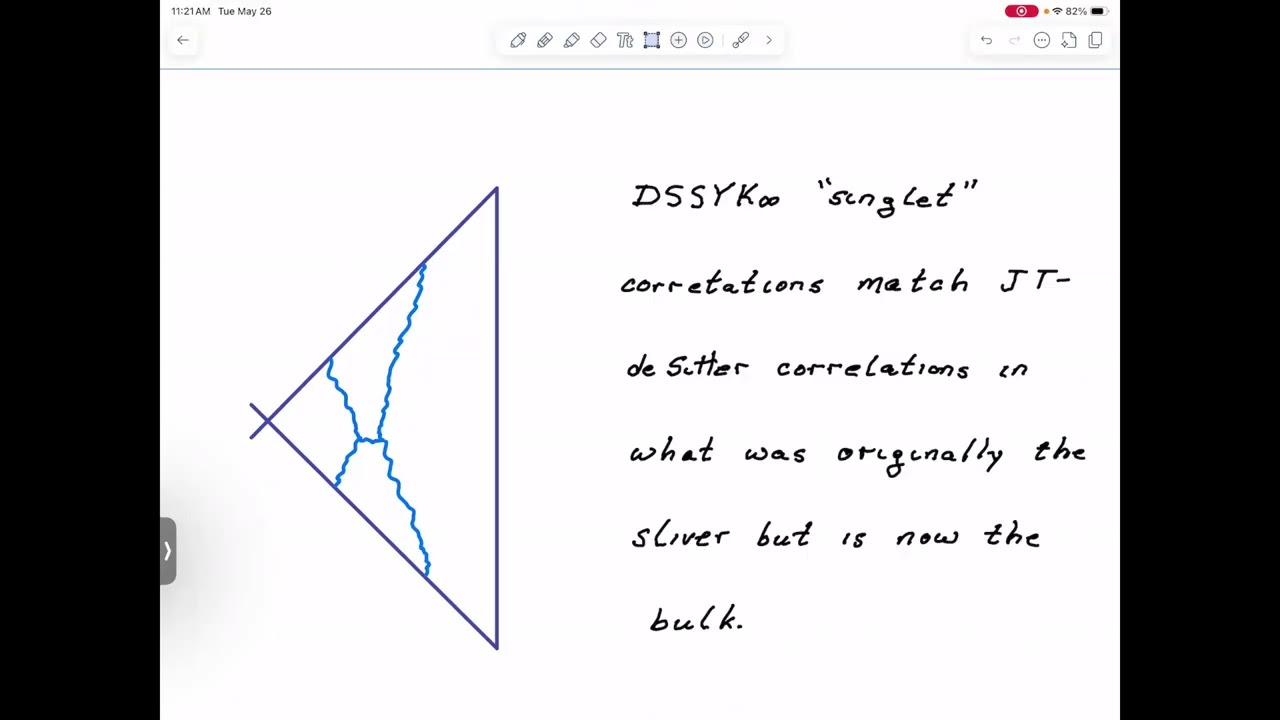
Leonard Susskind, speaking at the Institute for Advanced Study, lays out two toy models that physicists use to test ideas about holography, the proposal that gravity in a volume of space can be described by a theory living on its boundary. One is the double-scaled Sachdev-Ye-Kitaev model taken to its infinite coupling limit, DSSYK-infinity, a solvable quantum system built from randomly coupled fermions that has become a testing ground for holographic dualities. The other is the 't Hooft model, the exactly solvable large-N limit of two-dimensional QCD that 't Hooft worked out in the 1970s. Susskind walks through what each model can and cannot capture about bulk geometry, entropy, and the emergence of a dual gravitational description, treating them as parallel case studies rather than competitors. Delivered to a seminar audience at IAS's Bloomberg Lecture Hall, the talk assumes graduate-level familiarity with quantum field theory and string theory and moves through the technical comparison at a correspondingly fast pace.