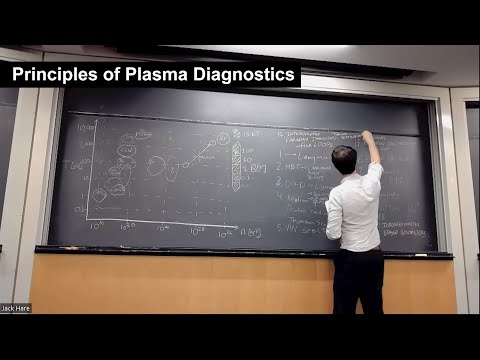
Introduction to Principles of Plasma Diagnostics
Jack Hare opens MIT's 22.67J Principles of Plasma Diagnostics by laying out why plasmas need dedicated diagnostic techniques in the first place. He surveys the range of plasmas the course will address, from fusion devices to astrophysical and laboratory plasmas, and explains how their densities, temperatures, and timescales differ enough that no single measurement method works across all of them. The lecture frames the central challenge of the field: plasmas are hot, often transient, and hard to probe without disturbing them, so diagnostics must be chosen to match the physical regime being studied. Hare sets up the course's scope, previewing the categories of diagnostic tools to come, such as optical, magnetic, and particle-based methods, and ties each back to the physical questions researchers actually want answered. It is a grounding session, establishing vocabulary and motivation before the technical content of later lectures.