Learning from Complexity
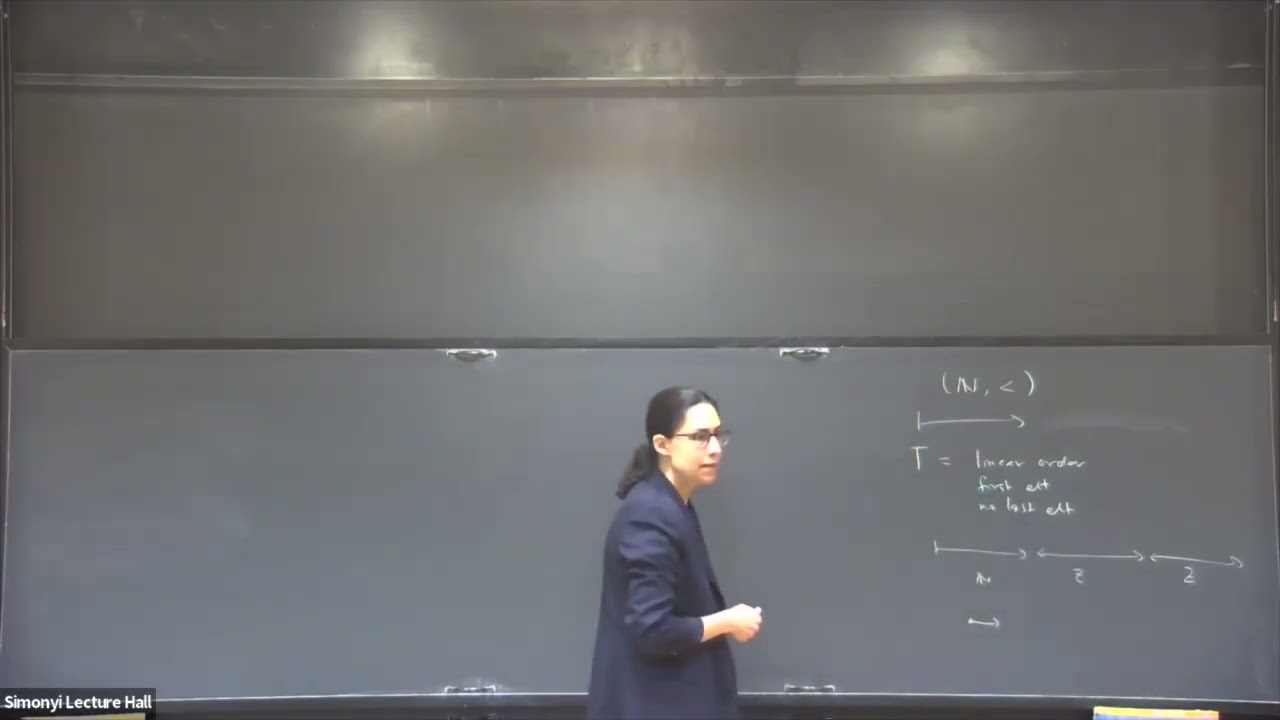
Maryanthe Malliaris of the University of Chicago delivers the Hermann Weyl Lecture at the Institute for Advanced Study, tracing a line from Hilbert's 1900 problems through the development of model theory. She opens with Hilbert's own framing, citing Cauchy, Bolzano, and Cantor on the continuum and Gauss, Bolyai, and Lobachevsky on non-Euclidean geometry, to show how definitions and the interplay of axioms and models drove nineteenth century mathematics toward a new field. From there she builds up the basic vocabulary, theories, models, types, and ultrapowers, and walks through Keisler's 1960s question about the saturation of regular ultrapowers, a problem that stayed stuck for decades while reshaping Shelah's theory of stability. The lecture's center is recent progress on that old question and its surprising ties to irregular pairs in Szemeredi's regularity lemma from combinatorics and to differential privacy in theoretical computer science. It is a working mathematician's account of how one technical puzzle quietly connects logic, combinatorics, and learning theory.