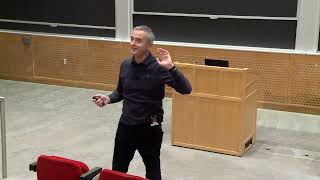
Lecture 16: Convergence and Cross-Country Variation
Ricardo Caballero continues MIT's 14.02 Principles of Macroeconomics with a lecture on convergence, the theory that poorer economies should grow faster than richer ones and close the income gap over time. He works through the Solow growth model's predictions for cross-country variation, asking why some nations catch up to the United States and others stay far behind. The lecture compares conditional versus absolute convergence, bringing in savings rates, population growth, and technology differences as the variables that explain divergent outcomes across countries. Caballero uses data and growth regressions to test whether the model's predictions hold up against actual national income trajectories since the mid-twentieth century. The forty-seven minute session builds directly on earlier Solow model material from the course, pushing students from abstract theory toward the empirical question of why global growth has been so uneven.