More Accurate and Complete Waveform Models for Gravitational-Wave Astrophysics: From Theory to Observations
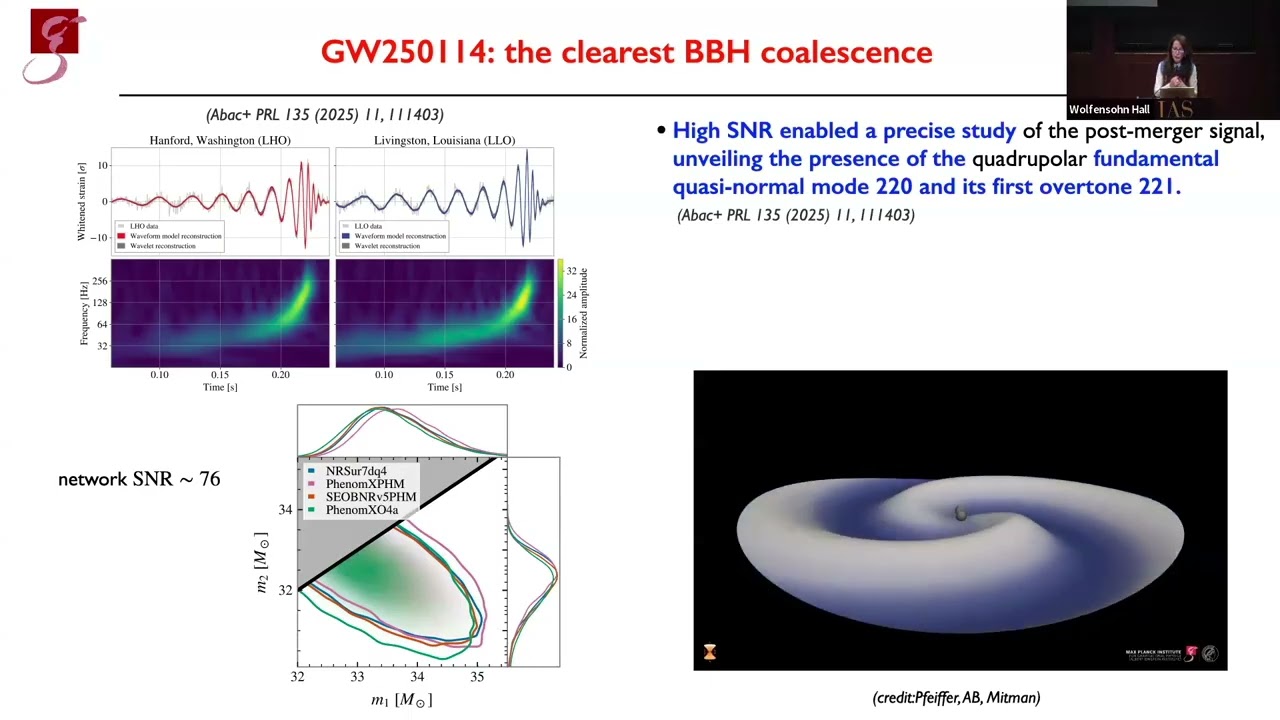
Alessandra Buonanno, director at the Max Planck Institute for Gravitational Physics, lays out how physicists model the gravitational-wave signals produced when black holes and neutron stars spiral together and merge. Speaking at the Institute for Advanced Study's Wolfensohn Hall as part of the Black Holes from Theory to Observations program, she traces the theoretical pipeline that turns Einstein's equations into the template waveforms LIGO and Viro use to extract real signals from detector noise. She covers how numerical relativity simulations, post-Newtonian expansions, and effective-one-body techniques are combined to capture higher-order effects such as spin precession and higher harmonic modes, and explains why more complete models matter as detectors grow sensitive enough to catch fainter, more complex mergers. The talk is aimed at researchers already familiar with general relativity and gravitational-wave data analysis, walking through specific modeling approaches rather than giving a general-audience overview of black hole astrophysics.