Observation of the Yamaji Effect in a Cuprate and FL* Theory of the Pseudogap
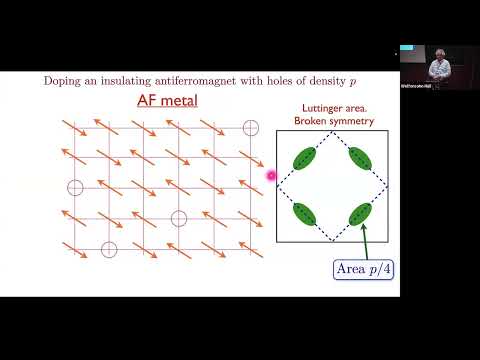
Subir Sachdev, physicist at Harvard University, presents recent work on the pseudogap phase of cuprate superconductors at the Institute for Advanced Study's Workshop on Ultra-Quantum Matter. He starts from two puzzling experimental facts: photoemission shows Fermi arcs rather than full Fermi surfaces, while magnetotransport measurements point to hole pockets. Sachdev argues these are reconciled by the Fractionalized Fermi liquid, or FL*, a theory that predicted hole pockets with fractional area p/8, where p is the doping level, a prediction he connects to newly measured Yamaji angles in cuprate samples. He walks through how thermal fluctuations in an SU(2) gauge theory describing the background spin liquid of FL* produce the observed Fermi arcs, and how the same framework yields conventional d-wave superconductivity at low temperature. The talk is aimed at condensed matter physicists already familiar with cuprate phenomenology and gauge theory approaches to strongly correlated electron systems, laying out both the experimental evidence and the theoretical machinery built to explain it.