The Astrophysics of Binary Black Holes After a Decade of Gravitational-Wave Observations
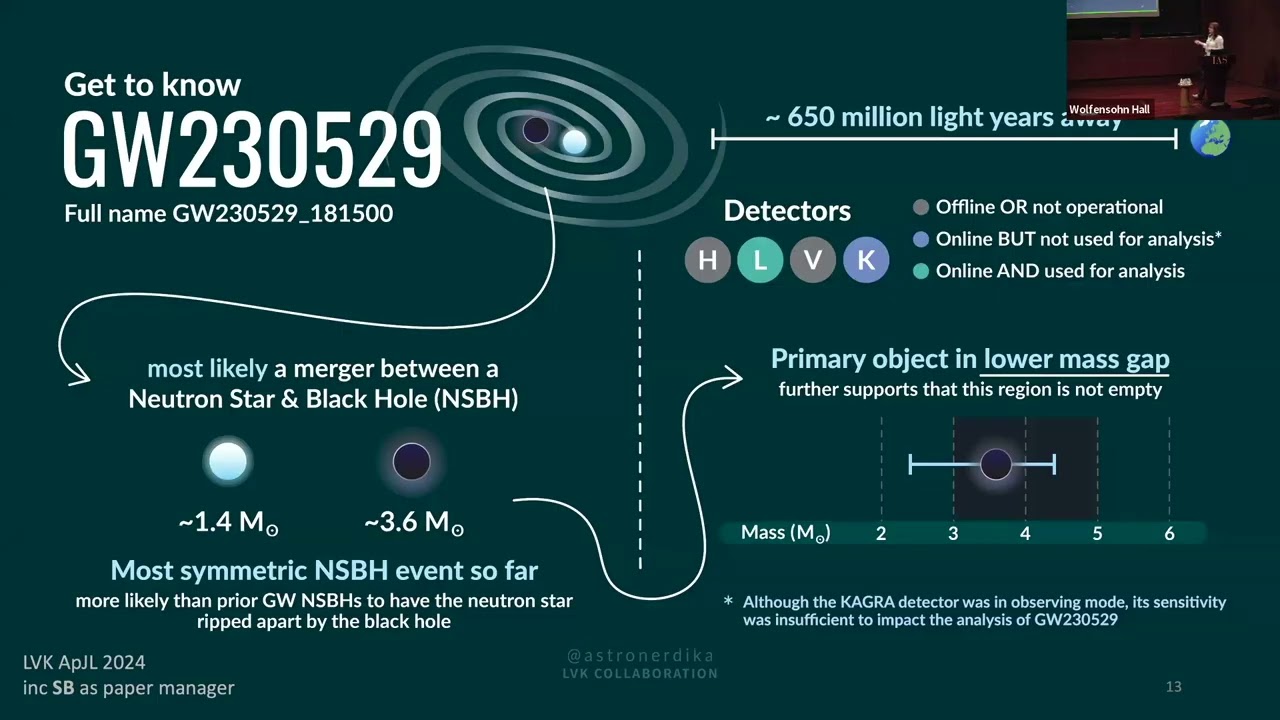
Sylvia Biscoveanu, an astrophysicist at Princeton University, surveys what a decade of gravitational-wave detections has revealed about binary black holes since LIGO's first observation in 2015. Speaking at the Institute for Advanced Study's Wolfensohn Hall as part of the Black Holes from Theory to Observations series, she walks through how LIGO and Virgo have grown from a single detection to a catalog of mergers, and what the masses, spins, and distances of those binaries tell researchers about how black holes form and pair up in the first place. She covers competing formation channels, including binaries born from stellar pairs and those assembled dynamically in dense clusters, and discusses how population-level statistics across many events help distinguish between them. The talk also touches on current limits of detector sensitivity and what upgraded and future observatories might add. It is a researcher's progress report on a field that went from theoretical prediction to routine observation within one decade.