The Cosmological Collider: An Observational Perspective
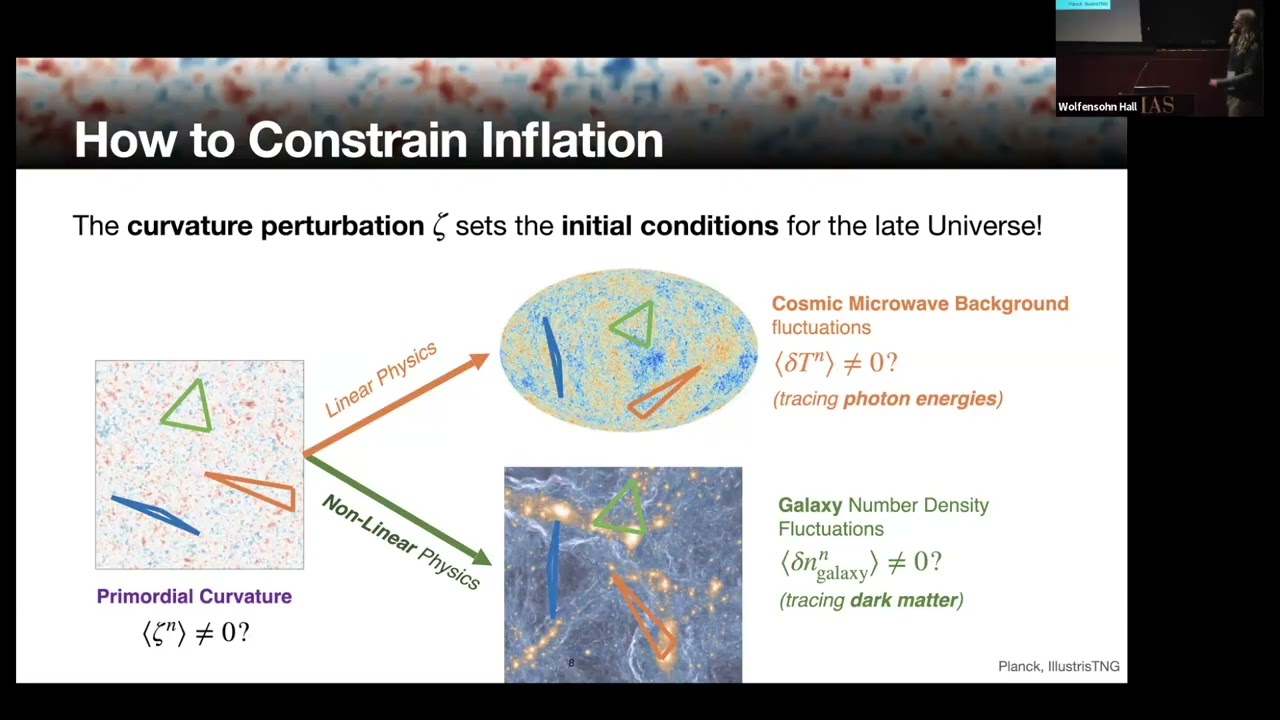
Oliver Philcox, a cosmologist at Stanford University, argues that signatures of new heavy particles during cosmic inflation, the so called cosmological collider, might actually be detectable in existing survey data. Speaking at the MPG-IAS-NTU Center kick off conference in Wolfensohn Hall, he walks through how non-Gaussian correlations in the distribution of galaxies and in the cosmic microwave background encode information about particle masses and spins present fractions of a second after the Big Bang. He reviews current observational bounds from large scale structure surveys and the CMB, explains why these signals are so faint, and lays out what statistical techniques and future datasets would be needed to actually pull a clear detection out of the noise. The talk is aimed at researchers already familiar with inflationary cosmology and treats the collider idea as a near term observational target rather than a purely theoretical curiosity.