The Extremal Black Hole Threshold
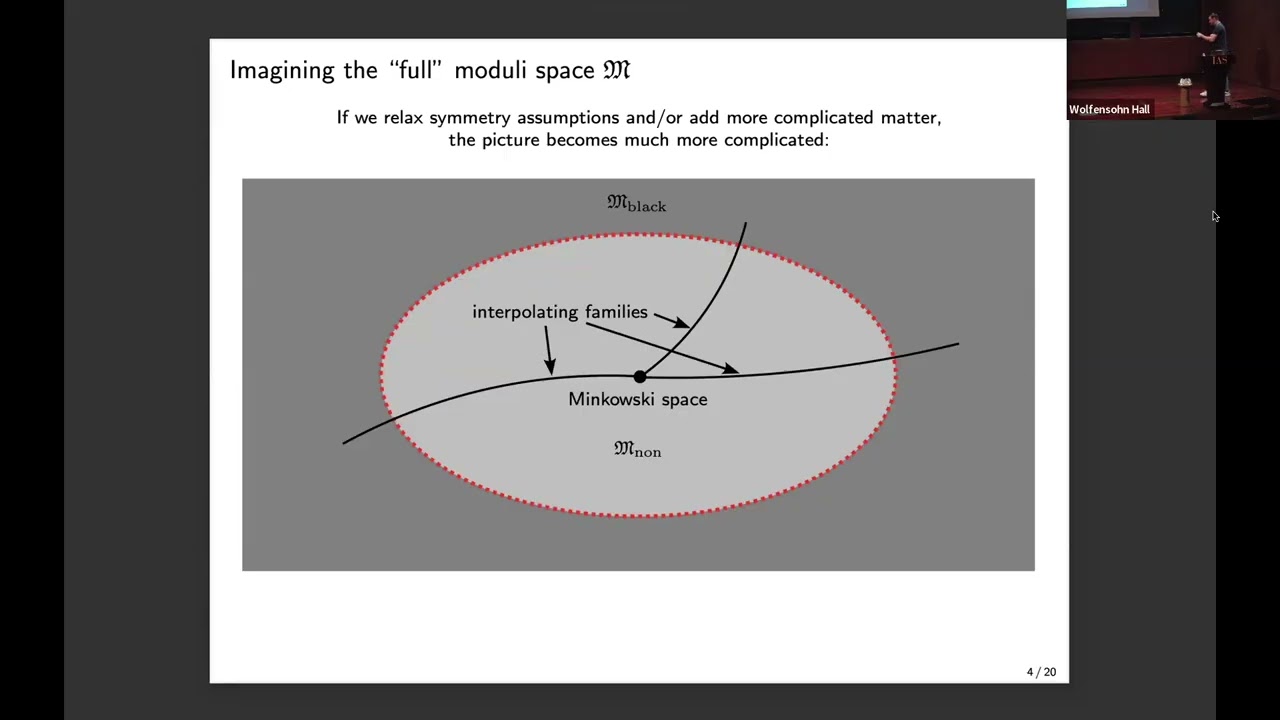
Ryan Unger, a mathematician at UC Berkeley working in general relativity, talks about what happens as a black hole approaches the extremal limit, the point where its mass is balanced exactly against its charge or spin and the horizon's surface gravity drops to zero. Speaking at the Institute for Advanced Study as part of a workshop on black holes from theory to observations, Unger connects this threshold to the third law of black hole thermodynamics, which says extremality cannot be reached by any physical process in finite time, and to recent mathematical work testing whether that law actually holds under dynamical collapse. He walks through the geometry of near-extremal horizons and the analytic obstructions that make them behave differently from ordinary black holes, drawing on his and collaborators' results in mathematical relativity. The talk is aimed at researchers already familiar with black hole spacetimes rather than a general audience, and stays close to the technical arguments rather than observational consequences.