The Large-Scale Structure of Baryons with Fast Radio Bursts
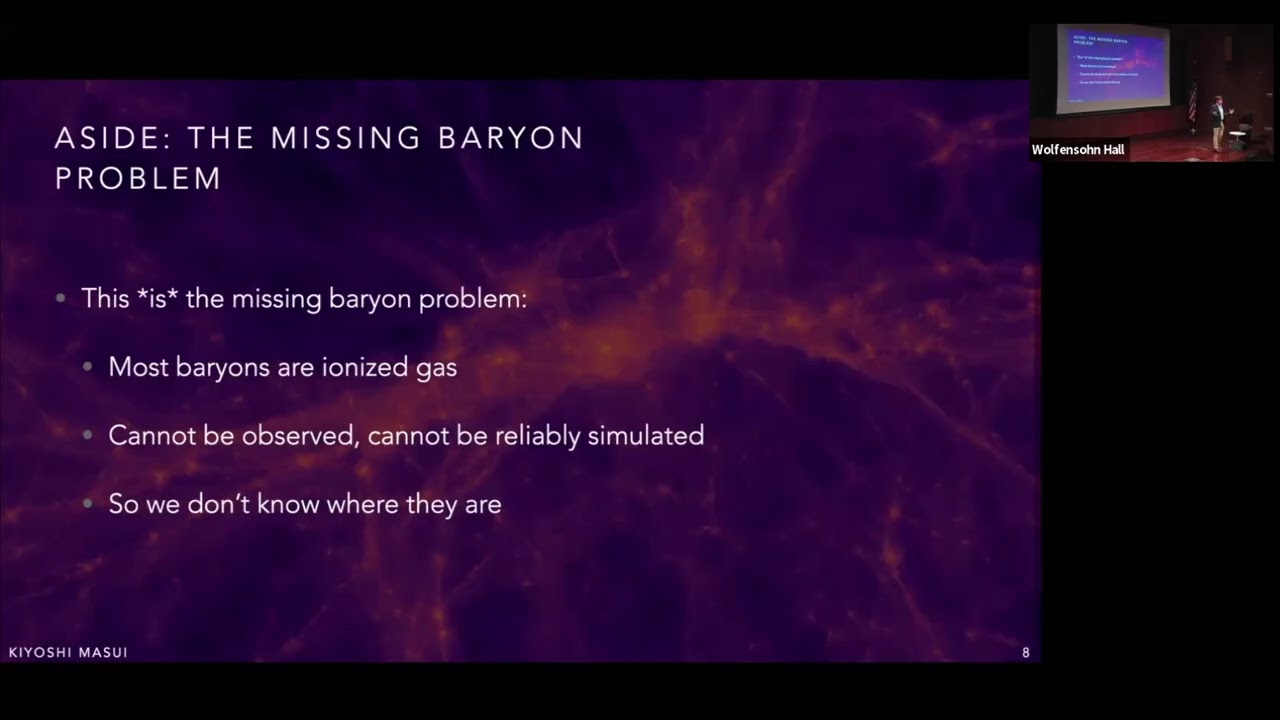
Kiyoshi Masui of MIT argues that fast radio bursts offer a new way to map the universe's missing baryons, in this talk for the Institute for Advanced Study and Princeton University's Joint Astrophysics Colloquium. He explains why diffuse ionized gas, the bulk of ordinary matter left over after galaxy formation, resists direct observation and now stands as the dominant systematic error in cosmological measurements, since supernovae and black hole feedback scatter it unpredictably. Each fast radio burst, a millisecond flash from a distant galaxy, gets smeared by exactly the amount of ionized gas it passes through, so correlating dispersion across many bursts with galaxy survey data reconstructs the large-scale statistics of that gas. Masui details how the Canadian Hydrogen Intensity Mapping Experiment, with its new Outrigger telescopes, localizes bursts precisely enough to identify host galaxies for optical follow-up, turning this into a working precision tool for galaxy evolution and cosmology. The talk runs just over an hour and assumes graduate-level familiarity with cosmological structure formation.