The Radiation (Magneto-)Hydrodynamics of Tidal Disruption Events
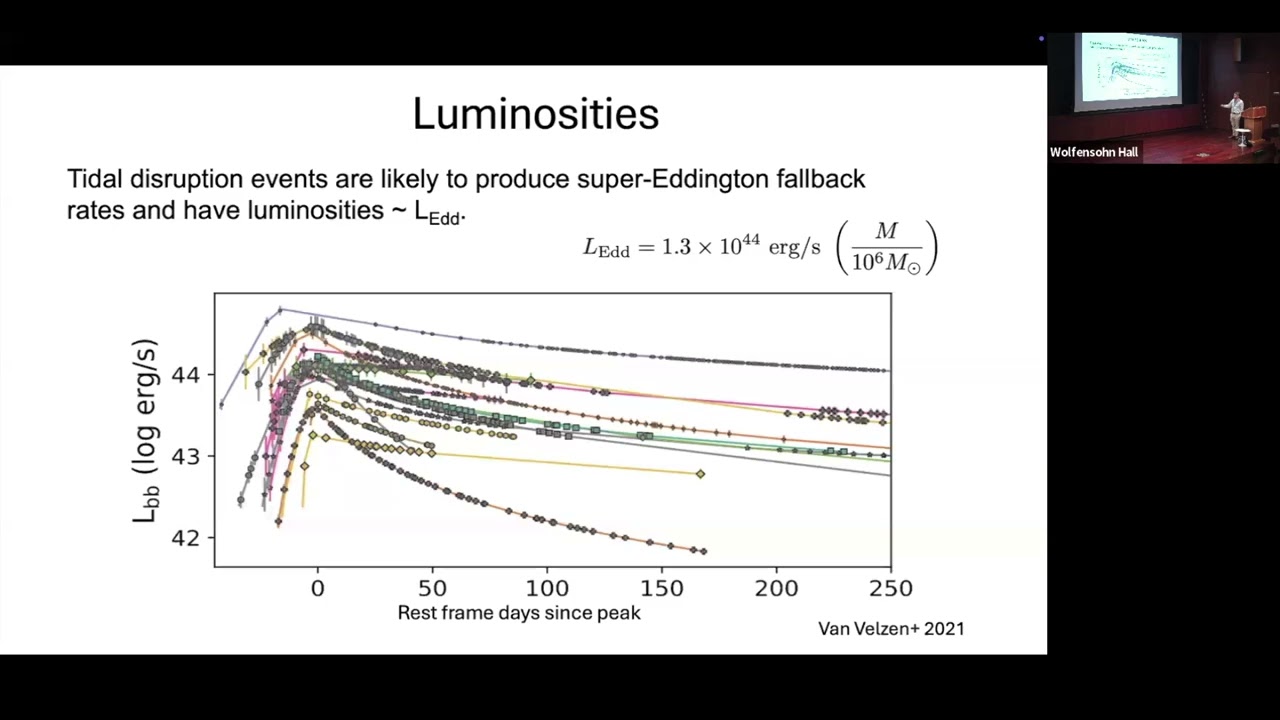
Shane Davis, an astrophysicist at the University of Virginia, presents this Institute for Advanced Study and Princeton Joint Astrophysics Colloquium on tidal disruption events, the flares produced when stars are torn apart by black holes. He walks through simulations built with the Athena++ and AthenaK codes that solve the radiation transfer equation to capture how radiation forces shape these super-Eddington flows, including new results computed directly in Kerr spacetime around a spinning black hole. Davis explains why the stream of disrupted stellar debris is slow to settle into a disk, and how shocks between infalling and returning gas, rather than full circularization, drive the early release of energy and angular momentum. He also describes how radiation pressure launches unbound outflows and builds a reprocessing envelope of bound material, a mechanism that may explain the optical and ultraviolet light seen from many observed disruption events.