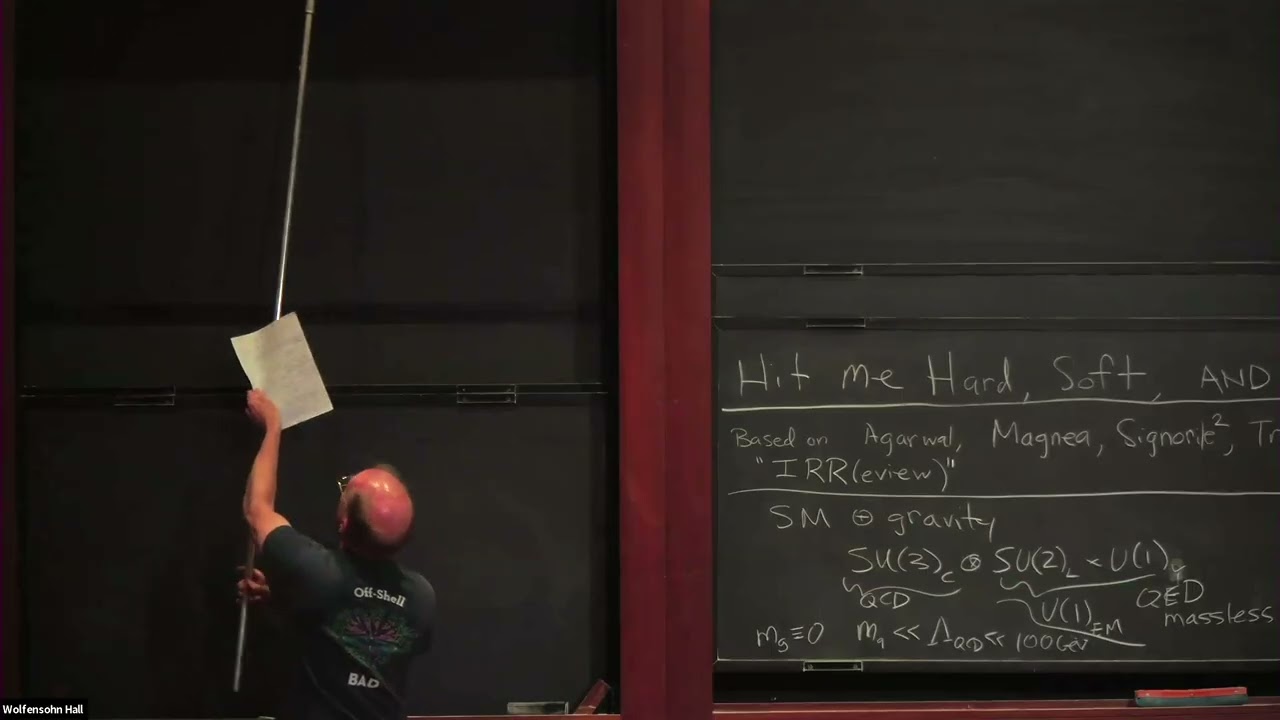
The Soft and Collinear Structure of Scattering Amplitudes, Part 1
Lance Dixon of Stanford University opens a two-part lecture on the soft and collinear limits that govern how scattering amplitudes in quantum field theory behave when particles become very low in energy or nearly parallel. Delivered as part of the Institute for Advanced Study's Prospects in Theoretical Physics 2026 program, the talk builds up the formalism physicists use to isolate these singular limits, showing how soft gluon emission and collinear splitting produce universal factorized structures that recur across different theories and loop orders. Dixon connects this machinery to its practical payoff: taming infrared divergences in perturbative calculations and extracting the finite, physically meaningful parts of scattering cross sections. Expect blackboard-style derivations and references to the modern amplitudes literature, pitched at an audience already comfortable with quantum field theory and perturbation theory. As the first of two parts, it lays the conceptual groundwork, from Wilson line techniques to factorization theorems, that the second lecture builds on.