The Ultra-Relativistic Limit of Black Hole Collisions
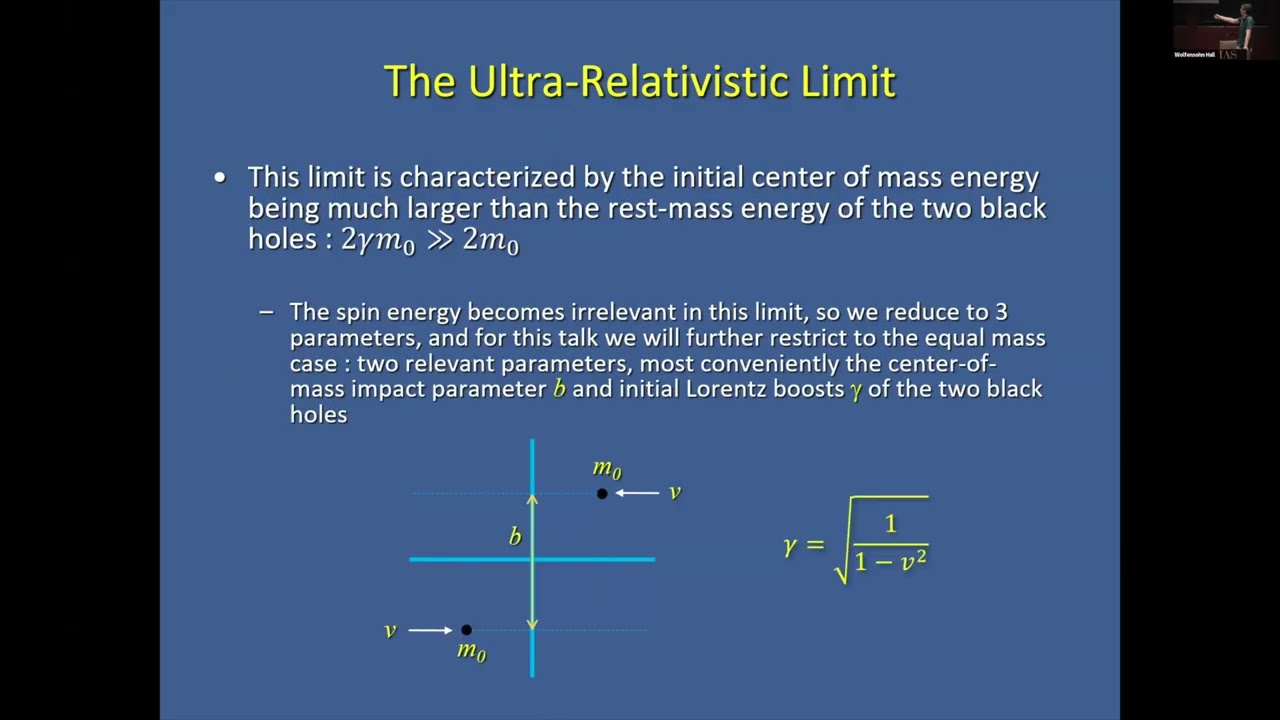
Frans Pretorius of Princeton University presents numerical relativity work on what happens when black holes collide at speeds approaching the speed of light. Recorded at the Institute for Advanced Study's Wolfensohn Hall as part of a workshop titled Black Holes from Theory to Observations, the talk walks through simulations of highly boosted black hole mergers, the gravitational radiation they produce, and how the ultra-relativistic regime connects to scattering amplitude calculations and high-energy collision physics more broadly. Pretorius discusses the technical challenges of evolving Einstein's equations numerically at these extreme velocities and what the results suggest about energy loss, trapped surfaces, and the eventual bound on how much gravitational wave energy a collision can radiate. The lecture assumes familiarity with general relativity and numerical methods, aimed at researchers working on strong-field gravity and gravitational wave astrophysics rather than a general audience.