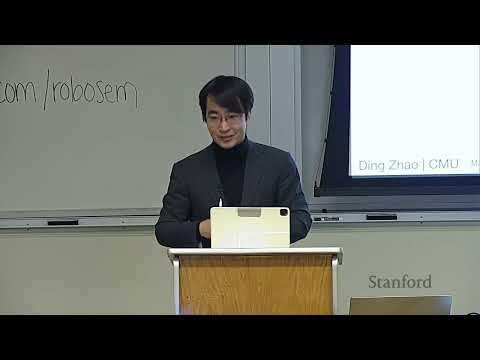
Towards Trustworthy Autonomy: Generalizability, Safety, Embodiment
Ding Zhao of Carnegie Mellon University argues that building trustworthy autonomy for self-driving cars and assistant robots requires tackling the messy statistics of real-world data, not just better models. He opens with the 'long-tailed' problem, the rare safety-critical events that standard training data barely represent, and connects it to safety evaluation and safe reinforcement learning. He then treats multi-modal uncertainty as distinct 'tasks' to improve generalization across domains, and describes prompt-transformer architectures his lab built to enable meta-learning and continual learning in vision and language without catastrophic forgetting. For situations with almost no data on unknown-unknown failure cases, he discusses pulling in external knowledge from legislative text, causal reasoning, and large language models. He closes by pushing the problem beyond software, proposing that robot morphology itself, the physical design of a system, can be engineered for safety and generalizability alongside algorithms. Delivered as a Stanford Seminar talk, it covers technical ground suited to viewers with some background in machine learning and robotics.