Wave Dark Matter (and Black Holes)
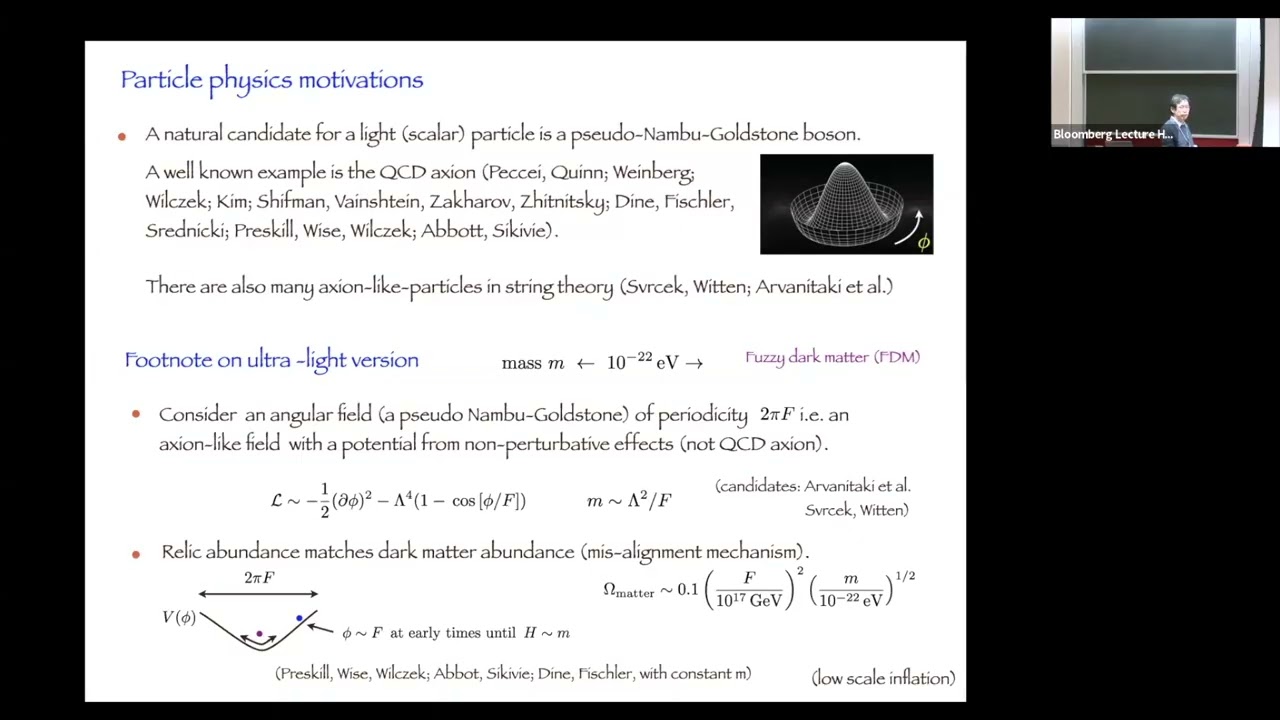
Lam Hui, a physicist at Columbia University, argues that if dark matter particles are lighter than about 10 eV, the substance behaves not as point particles but as a set of waves, with observable consequences. Speaking at the Institute for Advanced Study's astrophysics seminar, Hui walks through two recent lines of work built on this wave picture: caustic fringes that form where dark matter waves interfere, and a proposed ultra-broadband method for detecting axion dark matter across a wide range of frequencies. Time permitting, he closes with newer work on nonlinear perturbation theory for black holes, extending standard linear techniques to capture effects that only show up at higher order. The talk assumes some background in theoretical physics but keeps the core ideas, wave interference, detection bandwidth, and perturbative expansion, explained in plain terms before getting into the technical results.