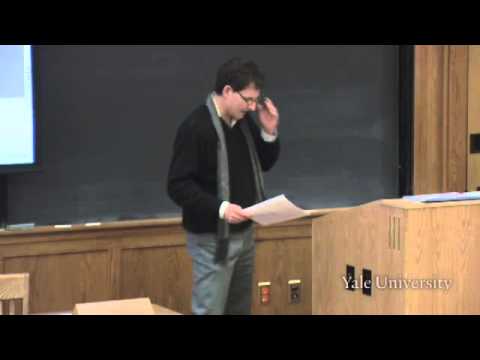
William Butler Yeats (cont.)
Langdon Hammer continues his account of Yeats in this Yale ENGL 310 lecture, tracing the poet's middle period as he took on the role of spokesman for Irish nationalism. Hammer reads "Easter, 1916" closely to examine how Yeats aestheticizes political violence, then turns to Yeats's broader theory of history, particularly the unsettling mixture of divine, human, and bestial forces that recurs in his visionary poems. "The Second Coming" and "The Magi" are analyzed for their apocalyptic imagery, and the lecture closes with a reading of "Leda and the Swan" as a culmination of these ideas about violence, myth, and historical change. Recorded in Spring 2007 as part of Yale's Open Yale Courses, the lecture is organized into chapters moving poem by poem through the material.