Error-Correcting Codes: Hamming Codes
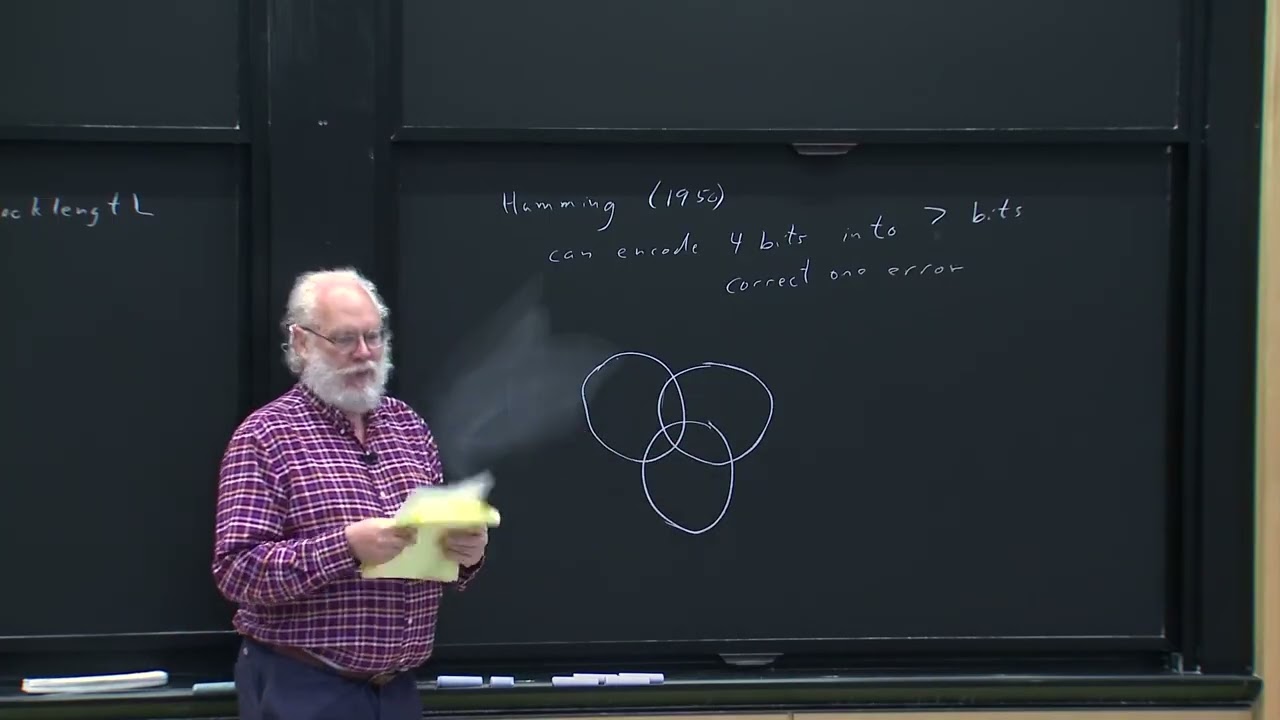
Peter Shor, teaching MIT's 18.200 Principles of Discrete Applied Mathematics, covers how information can be sent over a noisy channel and recovered correctly. He builds up the 7-bit Hamming code from scratch, showing how parity bits let a receiver detect and correct a single flipped bit, then generalizes to the broader framework of linear codes, where codewords form a vector space and error-correcting power comes from the minimum distance between them. The lecture closes by extending the construction to general Hamming codes of larger block length. Shor works through the algebra on the board step by step, connecting the abstract linear-algebra machinery back to the concrete 7-bit example so the generalization feels motivated rather than just asserted. Runtime is 79 minutes, consistent with a full MIT lecture session, and the material assumes some prior exposure to linear algebra and discrete math from earlier in the course.