Tail Bounds
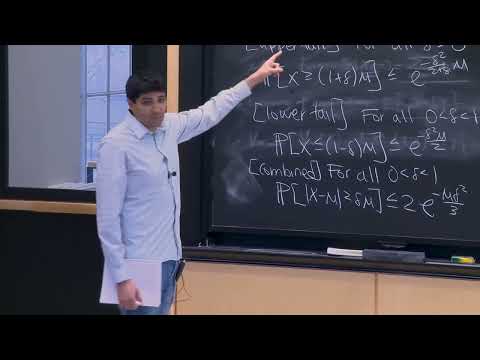
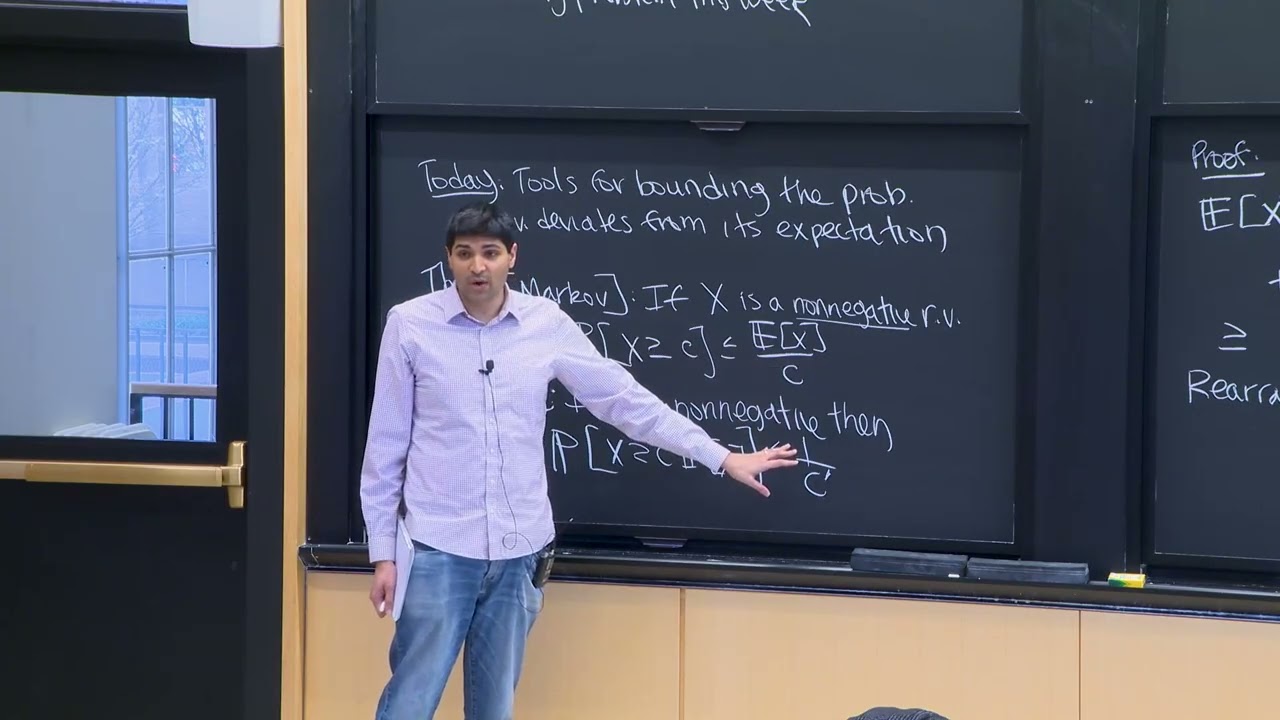
Ankur Moitra teaches lecture 8 of MIT's 18.200 Principles of Discrete Applied Mathematics, covering tail bounds, the tools that estimate how likely a random variable is to stray far from its mean. He derives Markov's inequality first, then builds Chebyshev's bound from it using the variance of a random variable. The lecture closes by applying Chebyshev's bound to prove the weak law of large numbers, showing how sample averages concentrate around the true mean as sample size grows. The style is standard MIT OCW blackboard lecture: full derivations worked step by step, with Moitra pausing to explain the intuition behind each inequality before moving to the next. Runtime is 81 minutes, consistent with a full class session rather than a clipped excerpt.