Extremal Set Theory: Intersecting Families
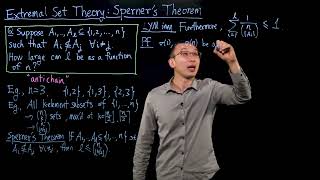
Yufei Zhao continues MIT's 18.226 Probabilistic Methods in Combinatorics with a session on extremal set theory. The central question: given an n-element set, how large can a family of k-element subsets be if every pair of subsets must intersect? Zhao builds toward the Erdos-Ko-Rado theorem, which pins down the exact maximum size of such an intersecting family, and shows how probabilistic arguments give a clean proof alongside the classical combinatorial one. The lecture fits into the course's broader project of using randomness and probability as tools to settle counting and extremal problems that resist purely combinatorial attack. Expect blackboard-style derivation, precise definitions of shifting and compression techniques where relevant, and a tight focus on one theorem worked through carefully rather than a survey of many results.