Threshold for a Random Graph to Contain a Triangle
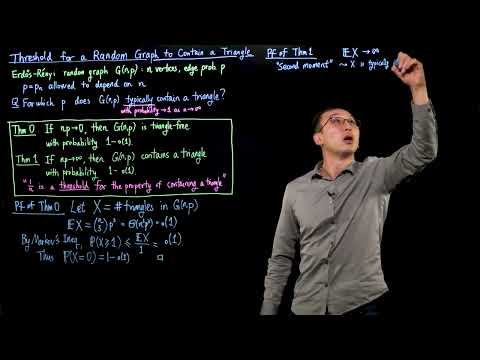
Yufei Zhao teaches a session of MIT's 18.226 Probabilistic Methods in Combinatorics, tackling the question of when a random graph typically contains a triangle. Working on the Erdos-Renyi model, he develops the threshold function for triangle appearance and shows how to pin it down using the first and second moment methods, the core toolkit of the probabilistic method. The lecture walks through computing the expected number of triangles, then uses variance estimates to show concentration around that expectation, demonstrating why the threshold is sharp rather than gradual. Zhao works through the calculations on the board step by step, connecting the abstract moment techniques to the concrete combinatorial count of triangles in a graph. Runtime is under half an hour, making it a focused treatment of a single technique rather than a broad survey, suited to viewers who already know basic graph theory and probability.