Fluid Dynamics (Lecture 1)
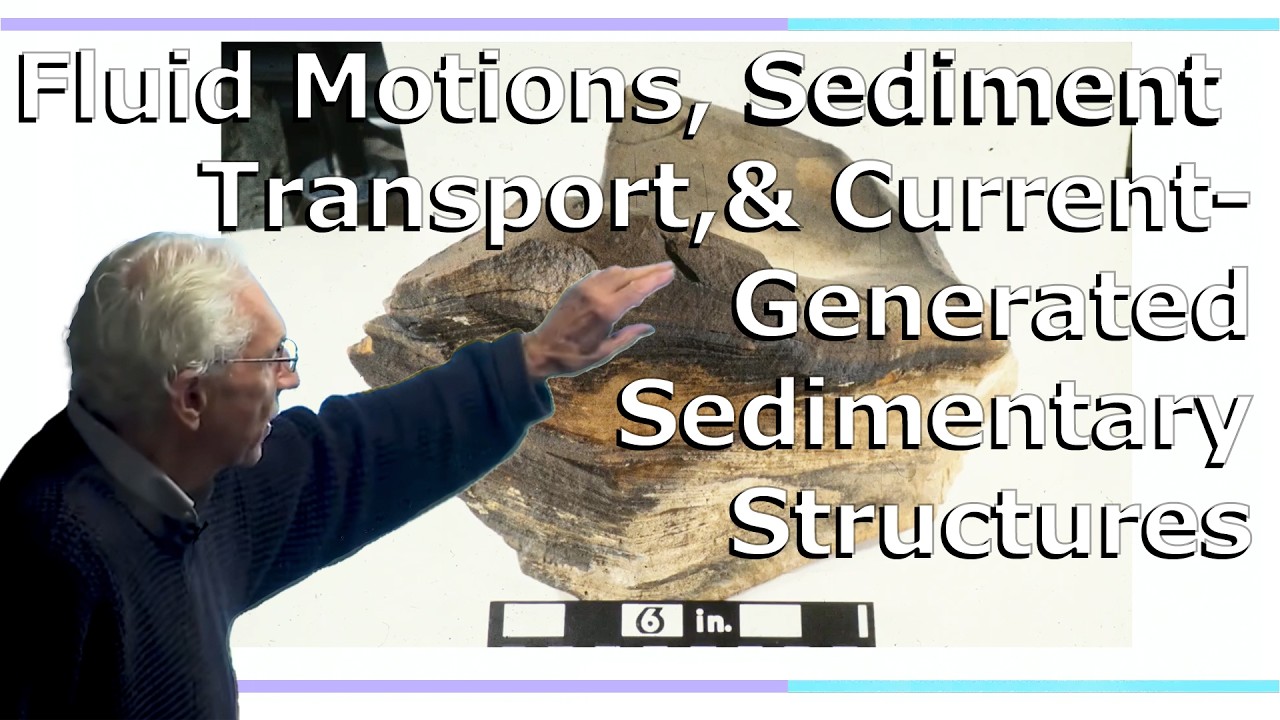
John Southard opens MIT's RES.12-003, Fluid Motions, Sediment Transport, and Current-Generated Sedimentary Structures, with the basics of how fluids move and shape sediment in rivers and oceans. He works through laminar versus turbulent flow, the Reynolds number, and dimensional analysis, drawing on classic experiments to show how flow behavior shifts with velocity. The lecture then covers the forces particles feel in moving water, drag, lift, and viscosity, and how flow behaves near channel boundaries. Southard extends the discussion to oscillatory flows produced by waves and to combined flow conditions where currents and waves interact. He closes by explaining how sediment grains begin to move, tying shear stress, particle size, and turbulence together through the Shields diagram, the standard tool for predicting the onset of sediment motion.