Mechanics of Sediment Transport
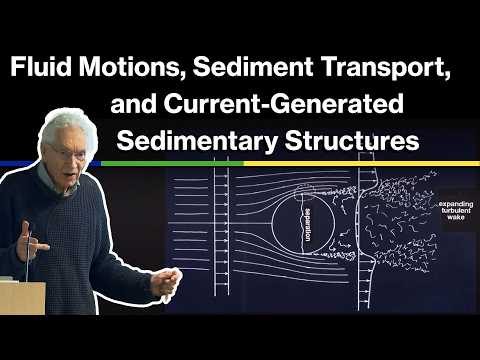
John Southard, in MIT's RES.12-003 Fluid Motions, Sediment Transport, and Current-Generated Sedimentary Structures, continues his sediment transport unit by explaining how particles actually move through a flow. He distinguishes bedload from suspended load, discusses transport rates, and walks through the practical difficulties of measuring sediment movement in rivers and other natural systems. The lecture then turns to aeolian transport, covering saltation and the density contrast between air and water that makes wind-driven sediment behave differently from water-driven sediment. Most of the hour goes to how bedforms like ripples and dunes form and evolve, drawing on laboratory flume experiments and field examples to show how flow velocity, grain size, and turbulence interact. Southard's throughline is feedback: bedforms are shaped by flow, and once formed, they reshape the flow that made them. It is a working geologist's lecture, chalk-and-diagram style, aimed at students already following the course.