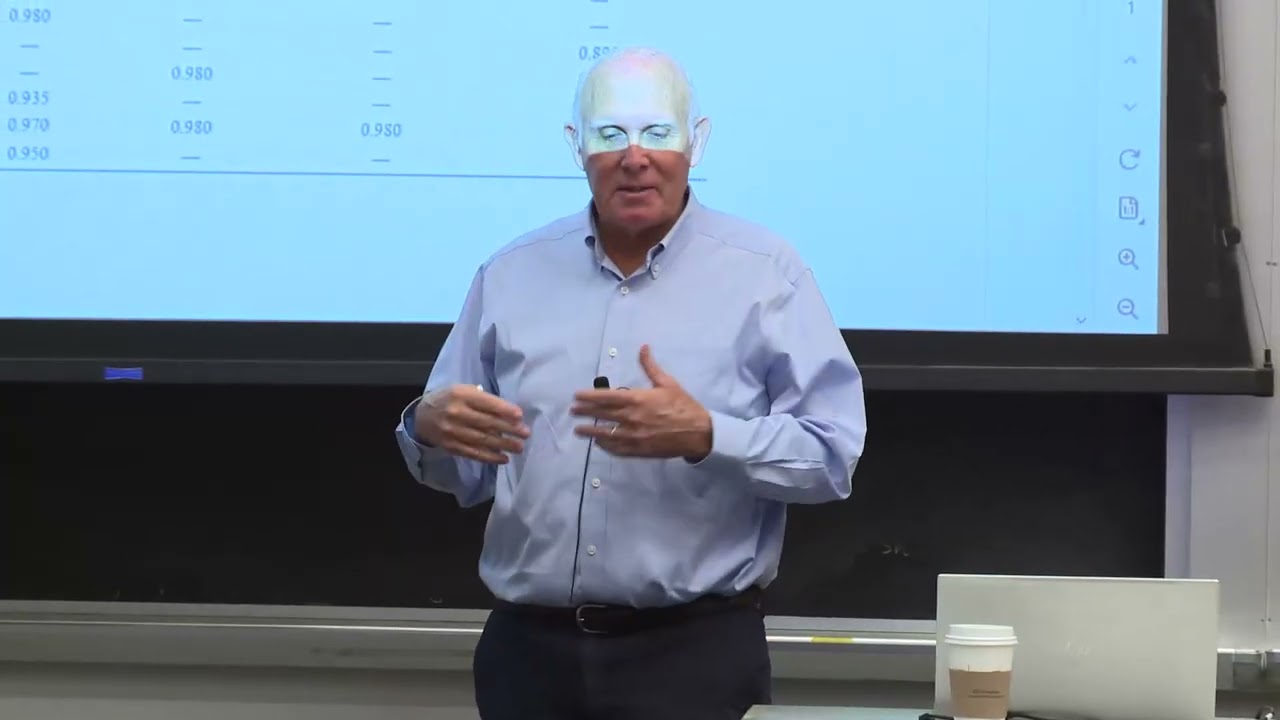
Volatility Modeling
Peter Kempthorne of MIT's 18.642, Topics in Mathematics with Applications in Finance, lays out the mathematics behind measuring and forecasting volatility. He moves from realized, historical, and implied volatility through estimation techniques including exponential moving averages and the Garman-Klass and Yang-Zhang range-based estimators. The lecture then turns to stochastic process models, covering geometric Brownian motion, jump diffusion, and time-varying volatility frameworks such as ARCH and GARCH. Kempthorne works through time series forecasting approaches and ties the theory to empirical case studies, comparing how well different estimators and models perform in practice. Running 82 minutes as part of the fall 2024 course, the lecture assumes familiarity with probability and stochastic calculus and is aimed at students building quantitative finance tools rather than newcomers to the subject.