Cancer: Clonal Evolution
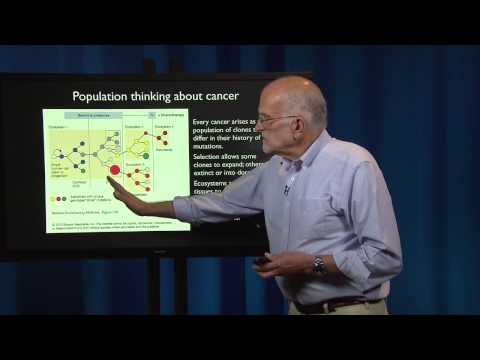
Stephen Stearns, teaching Yale's Evolution and Medicine course, explains cancer as an evolutionary process rather than a simple genetic malfunction. He walks through how a single cell lineage accumulates mutations over time, how natural selection then favors variants that divide faster, evade the immune system, or resist chemotherapy, and how this produces the clonal expansion and genetic heterogeneity found within a single tumor. Stearns draws on the framework of his 2015 textbook Evolutionary Medicine, co-published with Sinauer Associates, to show why tumors are better understood as evolving populations of cells competing inside the body than as a single disease entity. The lecture is short and dense, aimed at students already following the course's broader argument that Darwinian principles illuminate why bodies get sick, and it uses cancer as the clearest case where that logic plays out cell by cell, mutation by mutation, inside a single patient's lifetime.