Parts of the Soul II
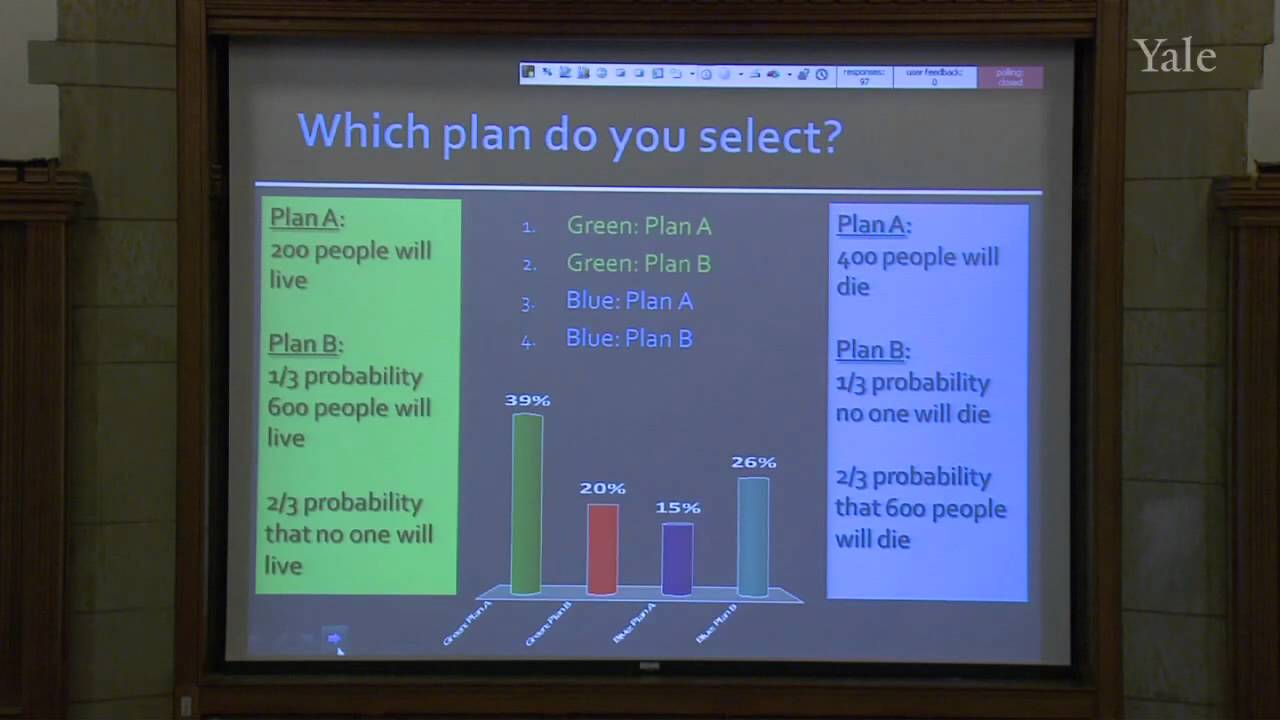
Tamar Gendler, teaching Yale's Philosophy and the Science of Human Nature, opens with a demonstration of sampling bias and what it means for empirical psychology. She returns to the lecture's running theme, divisions of the soul, through contemporary cognitive science. Dual-processing accounts of cognition are introduced alongside the Wason selection task and belief bias research, showing how reasoning can split into fast and slow tracks. Kahneman and Tversky's work on heuristics and biases follows, illustrated with the famous Asian disease framing experiment, where identical outcomes described differently produce different choices. Gendler closes by introducing her own concept of alief, distinguishing it from belief through several worked examples, such as fear responses that persist even when a person knows a threat is not real. The lecture connects ancient philosophical divisions of the soul to modern experimental psychology.