Few versus Many Particles: The Euler Relation; Review of Various Forms of Exergy (Part I)
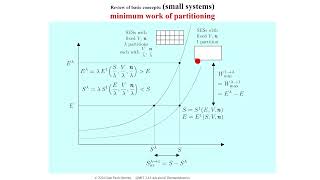
Gian Paolo Beretta continues MIT's 2.43 Advanced Thermodynamics course with a lecture on how systems behave differently depending on particle count. He opens with rarefaction effects near walls in few-particle systems, then introduces the simple-system model used to approximate many-particle systems, distinguishing microscopic, mesoscopic, and macroscopic descriptions. The core of the lecture derives the Euler relation and traces its main consequences, including what happens when partitions are inserted or removed in a system. Beretta then moves to bulk flow, covering local-equilibrium state models, bulk flow interactions, and pulsion work, showing how enthalpy enters the energy accounting for systems open to bulk flow, heat, and work. He closes with mass, energy, and entropy balances for open systems and begins a review of exergy forms and first- and second-law efficiencies, continued in the following lecture. Slides accompany the full ninety-six minute session.