Lecture 20: Chemical Kinetics, the Arrhenius Law, and Degree of Disequilibrium
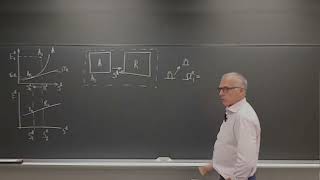
Gian Paolo Beretta continues MIT's 2.43 Advanced Thermodynamics course with a lecture on chemical kinetics and nonequilibrium reaction theory. He builds from the activated complex model and the Maxwell-Boltzmann velocity distribution to derive the Arrhenius activation barrier and collision-based reaction rates, using hydrocarbon oxidation as a worked example of detailed kinetic mechanisms. The core argument develops the principle of detailed balance and defines affinity as a degree of disequilibrium, showing how entropy production emerges as the product of affinity and reaction rate. Beretta also covers the fluctuation relation governing reaction direction, the half-equilibrium condition for activated complexes, and cases where some reactions proceed much faster than others. The lecture closes with an applied case, the buildup of nonequilibrium in supersonic nozzle expansion, connected to CO2 power laser operation. Slides accompany the recorded session, which runs close to an hour and a half.