LECTURES A GRATIS GLOBAL SERVICE
⌕ SEARCH GRATIS GLOBAL ↗
LECTURES
Properties of Reaction; Heating Values and Exergy of Fuels; Adiabatic Flame Temperature
SOURCE: YOUTUBE · NO TRACKING UNTIL YOU PRESS PLAY · TROUBLE PLAYING? WATCH AT THE SOURCE ↗

Properties of Reaction; Heating Values and Exergy of Fuels; Adiabatic Flame Temperature

99 MIN · EN · STATUS: [ STREAMING ]
RATE THIS
MIT · Advanced Thermodynamics · LECTURE 18

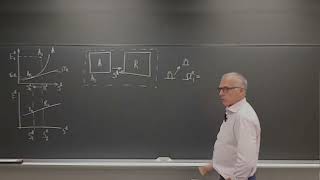
Gian Paolo Beretta continues MIT's 2.43 Advanced Thermodynamics course with a lecture on the thermodynamics of combustion. He develops stoichiometry and the proportionality relation, then builds up reactions of formation and the Hess relation using a fictitious ideal gas state at standard temperature and pressure. He compares enthalpy of formation against van der Waals forces and covalent bond energies on an H-S diagram, then asks when a reaction is product favored versus reactant favored and what that implies for maximum work obtainable or minimum work required. The second half turns to fuels directly: heating values and exergy of hydrocarbons, the distinction between lower and higher heating values, and the calculation of adiabatic flame temperature. The lecture closes by mapping the whole argument onto an energy versus entropy diagram and asking whether a reversible flame is physically attainable. Slides accompany the full ninety-nine minute session.
At a glance

Lecture facts

Runtime compared with the other 153 Engineering lectures
Runtime1 h 39 m
Compared with EngineeringLonger than 92%
This series

Advanced Thermodynamics

Every lecture in order, sized by its length.

  • Earlier lectures
  • This lecture
  • Still to come
Lecture 18 of 2527 h 51 m before this · 40 h 37 m in total

More from this course

12 LECTURES
Definitions of System, Property, State, and Weight Process; First Law and Energy

Definitions of System, Property, State, and Weight Process; First Law and Energy

MIT · 100 MIN
Lecture 2: Second Law and Entropy; Adiabatic Availability; Maximum Entropy Principle

Lecture 2: Second Law and Entropy; Adiabatic Availability; Maximum Entropy Principle

MIT · 101 MIN
Energy vs Entropy Diagrams to Represent Equilibrium and Nonequilibrium States

Energy vs Entropy Diagrams to Represent Equilibrium and Nonequilibrium States

MIT · 104 MIN
Lecture 4: Temperature, Pressure, Chemical Potentials; the Clausius Statement of the Second Law

Lecture 4: Temperature, Pressure, Chemical Potentials; the Clausius Statement of the Second Law

MIT · 94 MIN
Lecture 5: Definition of Heat Interaction; First and Second Law Efficiencies

Lecture 5: Definition of Heat Interaction; First and Second Law Efficiencies

MIT · 94 MIN
Lecture 6: Free Energies, Available Energies, and Stability Conditions

Lecture 6: Free Energies, Available Energies, and Stability Conditions

MIT · 93 MIN
Lecture 7: Availability Functions and the LeChatelier-Braun Principle

Lecture 7: Availability Functions and the LeChatelier-Braun Principle

MIT · 102 MIN
Few versus Many Particles: The Euler Relation; Review of Various Forms of Exergy (Part I)

Few versus Many Particles: The Euler Relation; Review of Various Forms of Exergy (Part I)

MIT · 96 MIN
Minimum Work of Partitioning Small Systems; The Gibbs Phase Rule; The Van der Waals Model

Minimum Work of Partitioning Small Systems; The Gibbs Phase Rule; The Van der Waals Model

MIT · 98 MIN
Review of Various Forms of Exergy (Part II); Allocation of Consumptions in Cogeneration

Review of Various Forms of Exergy (Part II); Allocation of Consumptions in Cogeneration

MIT · 102 MIN
Lecture 11: Allocation in Hybrid Power Production; Chemical Potentials and Partial Pressures

Lecture 11: Allocation in Hybrid Power Production; Chemical Potentials and Partial Pressures

MIT · 98 MIN
Lecture 12: Ideal Mixture Behavior; Work from Reversible Mixing; Entropy of Irreversible Mixing

Lecture 12: Ideal Mixture Behavior; Work from Reversible Mixing; Entropy of Irreversible Mixing

MIT · 101 MIN