Minimum Work of Partitioning Small Systems; The Gibbs Phase Rule; The Van der Waals Model
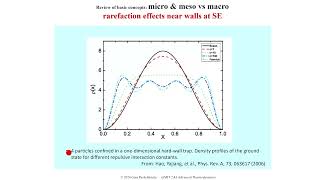
Gian Paolo Beretta continues MIT's 2.43 Advanced Thermodynamics course with a lecture on small-system thermodynamics and phase behavior. He opens by reviewing how equilibrium results derived for large systems extend to small and mesoscopic ones, covering rarefaction effects near walls and the limiting assumptions behind the simple-system model and its Euler relation. From there he works out the minimum work required to partition a small system, then turns to pure substances: extensive versus specific properties, intensive states, and the distinction between homogeneous and heterogeneous phases. The lecture builds to a proof of the Gibbs phase rule and its application to pure substances, followed by the Clausius-Clapeyron relation and its representation on p-T, u-v-s, h-s, and p-v diagrams. It closes with the van der Waals model of metastable liquid and vapor states. Slides accompany the hundred-minute session, which assumes familiarity with earlier lectures in the sequence.