LECTURES A GRATIS GLOBAL SERVICE
⌕ SEARCH GRATIS GLOBAL ↗
LECTURES
Lecture 5: Definition of Heat Interaction; First and Second Law Efficiencies
SOURCE: YOUTUBE · NO TRACKING UNTIL YOU PRESS PLAY · TROUBLE PLAYING? WATCH AT THE SOURCE ↗

Lecture 5: Definition of Heat Interaction; First and Second Law Efficiencies

94 MIN · EN · STATUS: [ STREAMING ]
RATE THIS
MIT · Advanced Thermodynamics · LECTURE 5

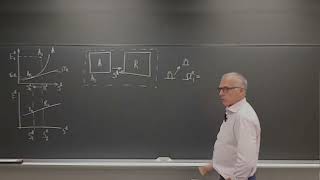
Gian Paolo Beretta continues MIT's 2.43 Advanced Thermodynamics course by formalizing what counts as a heat interaction, distinguishing it from work interactions and from informal notions of heat transfer. He builds a sharper version of the Clausius inequality, then shows why steady state heat transfer actually requires nonequilibrium, and how interposing a system between two reservoirs can make an otherwise irreversible exchange reversible. The core of the lecture works through heat engines, refrigerators, and heat pumps operating between two thermal reservoirs, deriving their first and second law efficiencies from the energy and entropy exchanges involved. The final stretch turns to measurement, covering thermometers, manometers, the distinction between pressure and force per unit area, and heat capacities and enthalpy at the board. Slides accompany the recorded lecture, and the instructor recommends 1.5x playback. This is dense, equation-driven graduate material delivered straight from the chalkboard.
At a glance

Lecture facts

Runtime compared with the other 153 Engineering lectures
Runtime1 h 34 m
Compared with EngineeringLonger than 88%
This series

Advanced Thermodynamics

Every lecture in order, sized by its length.

  • Earlier lectures
  • This lecture
  • Still to come
Lecture 5 of 256 h 39 m before this · 40 h 37 m in total

More from this course

12 LECTURES
Definitions of System, Property, State, and Weight Process; First Law and Energy

Definitions of System, Property, State, and Weight Process; First Law and Energy

MIT · 100 MIN
Lecture 2: Second Law and Entropy; Adiabatic Availability; Maximum Entropy Principle

Lecture 2: Second Law and Entropy; Adiabatic Availability; Maximum Entropy Principle

MIT · 101 MIN
Energy vs Entropy Diagrams to Represent Equilibrium and Nonequilibrium States

Energy vs Entropy Diagrams to Represent Equilibrium and Nonequilibrium States

MIT · 104 MIN
Lecture 4: Temperature, Pressure, Chemical Potentials; the Clausius Statement of the Second Law

Lecture 4: Temperature, Pressure, Chemical Potentials; the Clausius Statement of the Second Law

MIT · 94 MIN
Lecture 6: Free Energies, Available Energies, and Stability Conditions

Lecture 6: Free Energies, Available Energies, and Stability Conditions

MIT · 93 MIN
Lecture 7: Availability Functions and the LeChatelier-Braun Principle

Lecture 7: Availability Functions and the LeChatelier-Braun Principle

MIT · 102 MIN
Few versus Many Particles: The Euler Relation; Review of Various Forms of Exergy (Part I)

Few versus Many Particles: The Euler Relation; Review of Various Forms of Exergy (Part I)

MIT · 96 MIN
Minimum Work of Partitioning Small Systems; The Gibbs Phase Rule; The Van der Waals Model

Minimum Work of Partitioning Small Systems; The Gibbs Phase Rule; The Van der Waals Model

MIT · 98 MIN
Review of Various Forms of Exergy (Part II); Allocation of Consumptions in Cogeneration

Review of Various Forms of Exergy (Part II); Allocation of Consumptions in Cogeneration

MIT · 102 MIN
Lecture 11: Allocation in Hybrid Power Production; Chemical Potentials and Partial Pressures

Lecture 11: Allocation in Hybrid Power Production; Chemical Potentials and Partial Pressures

MIT · 98 MIN
Lecture 12: Ideal Mixture Behavior; Work from Reversible Mixing; Entropy of Irreversible Mixing

Lecture 12: Ideal Mixture Behavior; Work from Reversible Mixing; Entropy of Irreversible Mixing

MIT · 101 MIN
The Gibbs Paradox; Shannon Information Entropy; Single Quantum Particle in a Box

The Gibbs Paradox; Shannon Information Entropy; Single Quantum Particle in a Box

MIT · 100 MIN