Retaining an Atmosphere
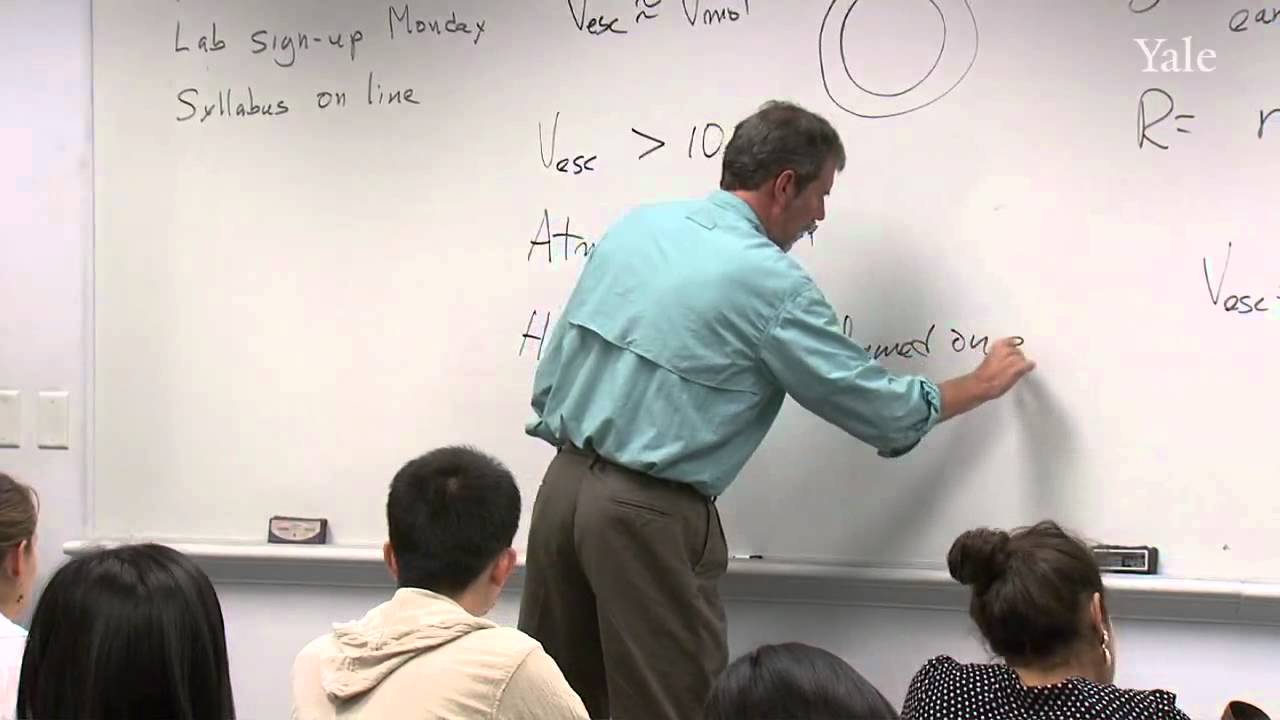
Ron Smith, teaching Yale's Atmosphere, the Ocean and Environmental Change, explains why some planets keep an atmosphere and others do not. He starts with how humans actually perceive air pressure, then works through escape velocity and how it depends on a planet's mass and radius. The core of the lecture covers molecular velocities, showing how a gas molecule's speed depends on its molecular weight and temperature, and why a molecule must exceed escape velocity to leave a planet's gravitational pull. Smith applies this to compare which planets in the solar system retain atmospheres and why, tying planetary characteristics like size and distance from the sun to atmospheric composition. The lecture closes with the vertical temperature profile of Earth's atmosphere. Chapters run from pressure perception through escape velocity, molecular velocities, planetary comparisons, and temperature structure, giving a complete physical account of atmospheric retention.