Auctions
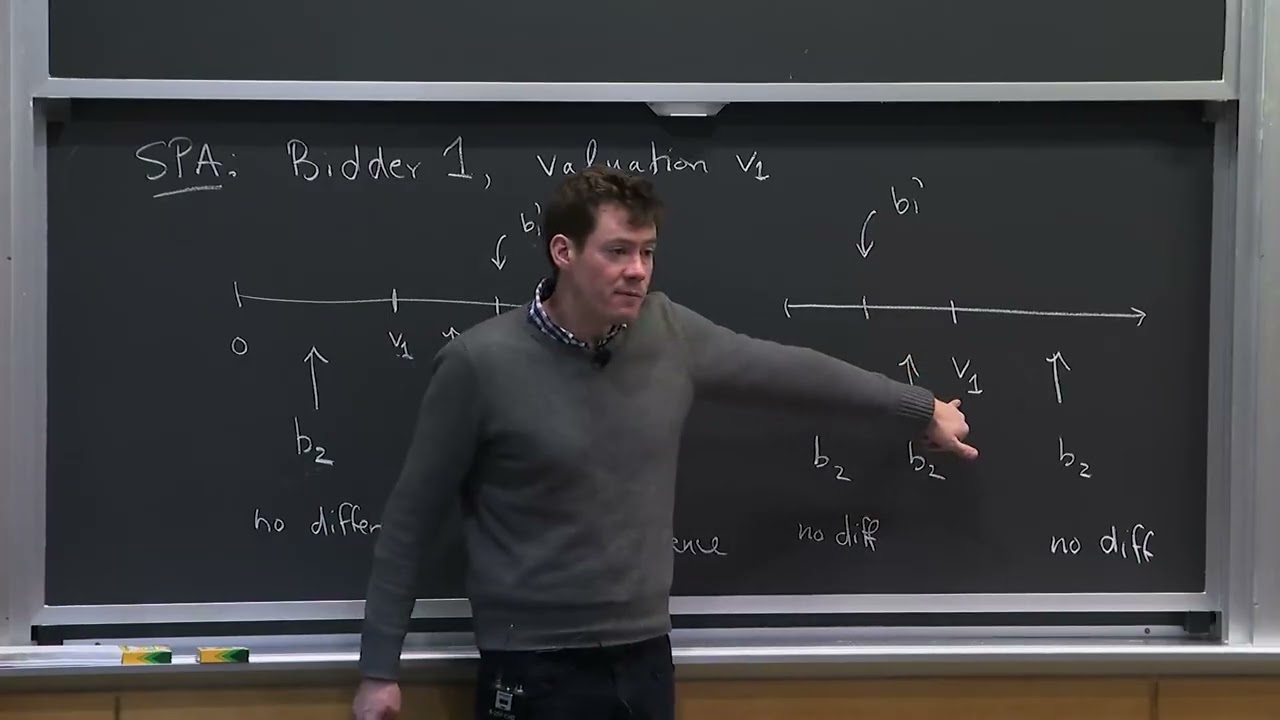
Ian Ball continues MIT's 14.12 Economic Applications of Game Theory with a lecture on auction theory, examining how bidders form strategies when payoffs depend on private valuations and guesses about competitors' behavior. He works through the two standard formats, first-price sealed-bid and second-price sealed-bid auctions, deriving how rational bidders should behave under each and comparing the resulting outcomes for the seller and for efficiency. The lecture builds on prior sessions in the game theory sequence, using formal notation and equilibrium concepts to analyze bidding strategy rather than relying on anecdote. At 79 minutes, it is a full classroom session aimed at students already comfortable with game-theoretic tools like Bayesian Nash equilibrium, walking through the mechanics of why second-price auctions tend to induce truthful bidding while first-price auctions require bidders to shade their bids below their true valuations.