Lecture 4: Rationalizability
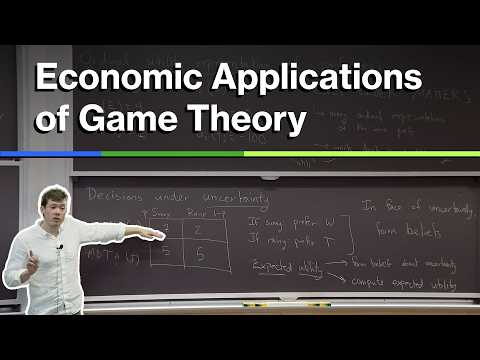
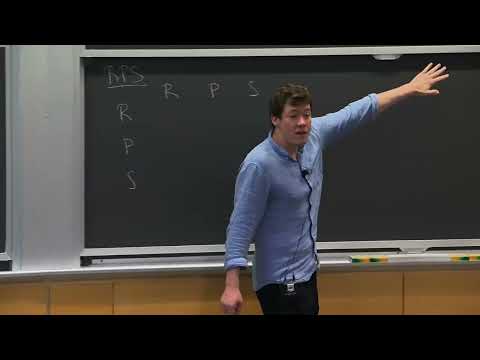
MIT economist Ian Ball teaches this session of 14.12, Economic Applications of Game Theory, on rationalizability, the game-theoretic concept identifying which strategies survive when players are assumed to be rational and to know that all other players are rational as well. Ball builds the idea from iterated elimination of strictly dominated strategies, showing how successive rounds of reasoning about opponents' rationality narrow down the plausible strategy set. The lecture works through formal definitions and examples on the board, connecting rationalizability to common knowledge assumptions and contrasting it with Nash equilibrium as a solution concept. Running 82 minutes, it is aimed at students already familiar with basic game theory notation and dominance arguments, and it fits within the course's broader sequence on strategic reasoning under uncertainty about others' beliefs and choices.