LECTURES A GRATIS GLOBAL SERVICE
⌕ SEARCH GRATIS GLOBAL ↗
LECTURES
Lecture 3: Dominance
SOURCE: YOUTUBE · NO TRACKING UNTIL YOU PRESS PLAY · TROUBLE PLAYING? WATCH AT THE SOURCE ↗

Lecture 3: Dominance

76 MIN · EN · STATUS: [ STREAMING ]
RATE THIS
MIT · Economic Applications of Game Theory · LECTURE 3

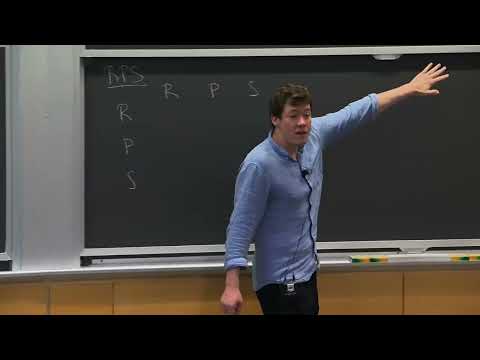
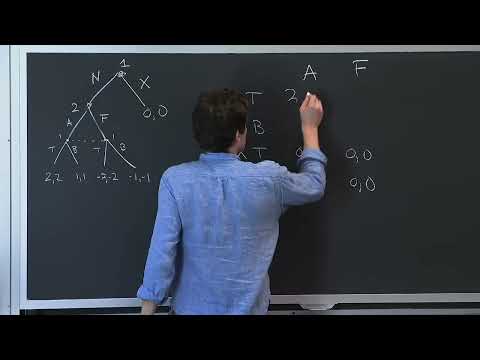
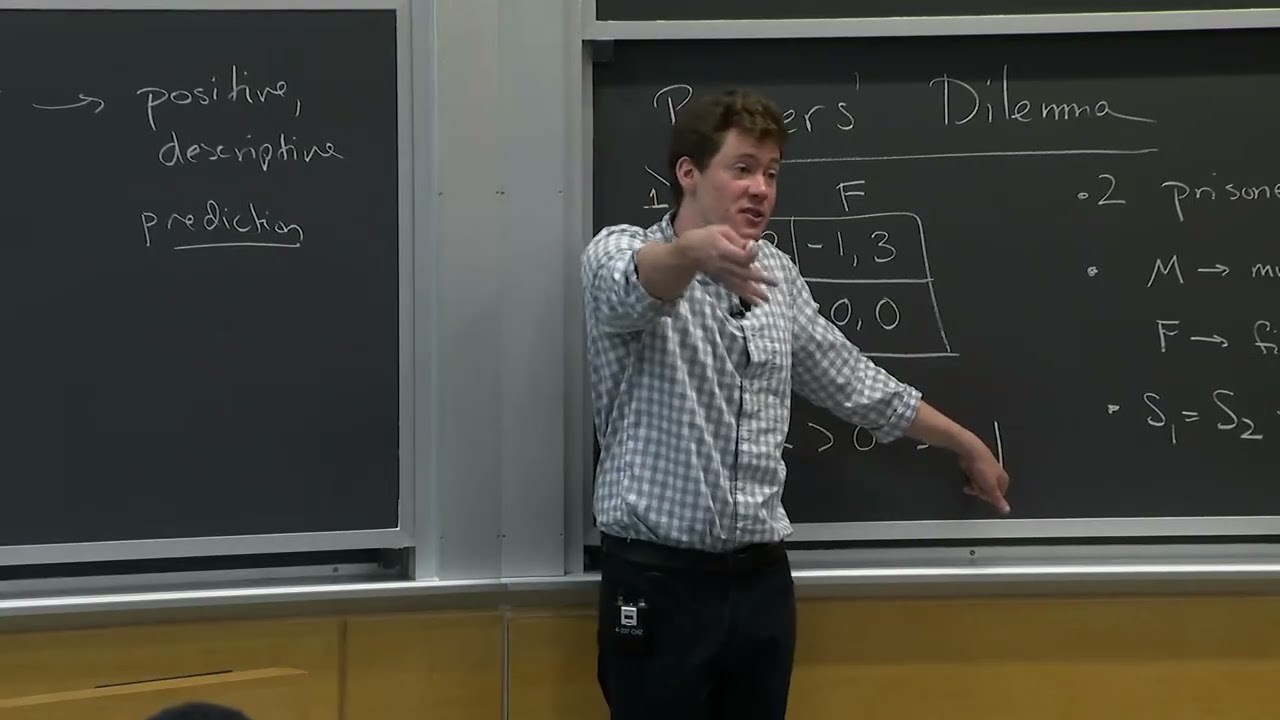
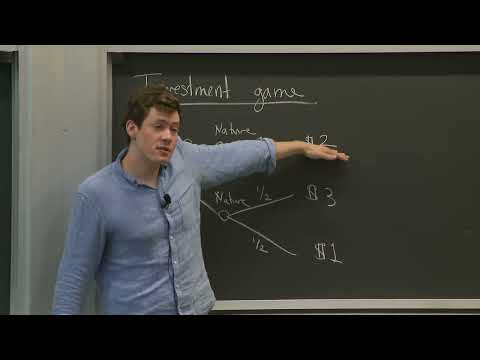
Ian Ball teaches the third lecture of MIT's 14.12 Economic Applications of Game Theory, working through the Prisoner's Dilemma as the entry point into formal strategic reasoning. He builds up the idea of a dominant strategy, one that beats every alternative regardless of what an opponent does, and contrasts it with best responses that depend on a guess about the other player's move. The session works through how to eliminate strategies that no rational player would ever choose, narrowing down which options are actually worth analyzing in a competitive game. Ball uses payoff matrices and worked examples on the board to show students how to spot dominance relationships quickly and why they matter for predicting outcomes before more complex equilibrium concepts get introduced later in the course. Seventy-six minutes of standard blackboard lecture aimed at students building the toolkit for economic game theory.
More from this course

12 LECTURES
Introduction to Individual Decision-Making

Introduction to Individual Decision-Making

MIT · 57 MIN
Representation of Games

Representation of Games

MIT · 73 MIN
Lecture 4: Rationalizability

Lecture 4: Rationalizability

MIT · 82 MIN
Lecture 5: Nash Equilibrium

Lecture 5: Nash Equilibrium

MIT · 79 MIN
Imperfect Competition

Imperfect Competition

MIT · 81 MIN
Zero-Sum Games

Zero-Sum Games

MIT · 81 MIN
Lecture 8: Backward Induction

Lecture 8: Backward Induction

MIT · 77 MIN
Lecture 9: Negotiation

Lecture 9: Negotiation

MIT · 74 MIN
Lecture 10: Subgame-Perfect Nash Equilibrium

Lecture 10: Subgame-Perfect Nash Equilibrium

MIT · 81 MIN
One-Shot Deviation Principle and Bargaining

One-Shot Deviation Principle and Bargaining

MIT · 78 MIN
Lecture 12: Finitely Repeated Games

Lecture 12: Finitely Repeated Games

MIT · 77 MIN
Lecture 13: Infinitely Repeated Games

Lecture 13: Infinitely Repeated Games

MIT · 82 MIN