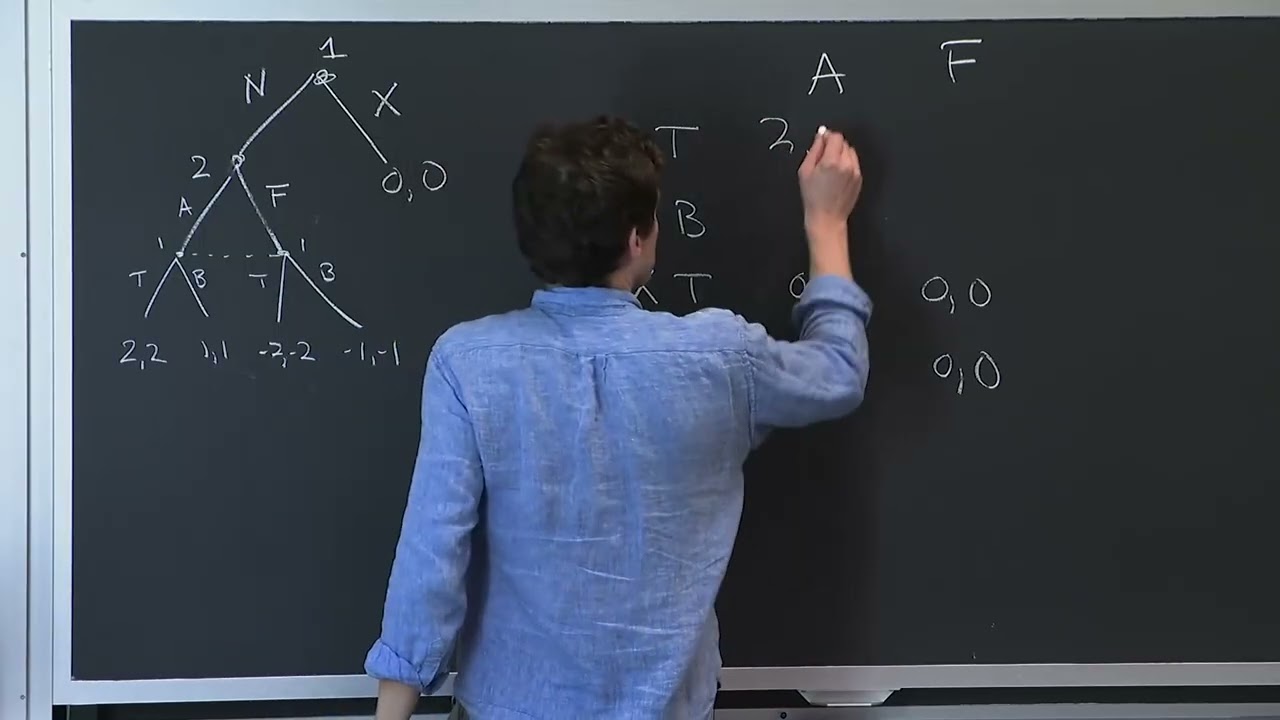
Lecture 10: Subgame-Perfect Nash Equilibrium
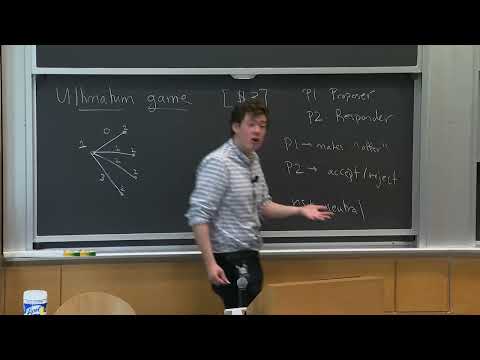
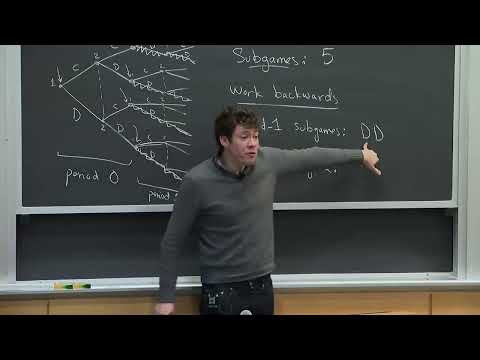
Ian Ball continues MIT's 14.12 Economic Applications of Game Theory with a lecture on subgame-perfect Nash equilibrium, the refinement of Nash equilibrium that requires every player's strategy to be optimal at every decision point in a game, not just along the path actually played. Ball works through the logic of backward induction and subgames within extensive-form games, showing why some Nash equilibria rely on threats that are not credible once a subgame is reached in isolation. The session builds on prior material in the course's game theory sequence, using formal notation and game trees to demonstrate how to check whether a strategy profile survives this stricter equilibrium concept. Eighty-one minutes of blackboard-style derivation aimed at students already familiar with basic Nash equilibrium and extensive-form representations.