LECTURES A GRATIS GLOBAL SERVICE
⌕ SEARCH GRATIS GLOBAL ↗
LECTURES
One-Shot Deviation Principle and Bargaining
SOURCE: YOUTUBE · NO TRACKING UNTIL YOU PRESS PLAY · TROUBLE PLAYING? WATCH AT THE SOURCE ↗

One-Shot Deviation Principle and Bargaining

78 MIN · EN · STATUS: [ STREAMING ]
RATE THIS
MIT · Economic Applications of Game Theory · LECTURE 11

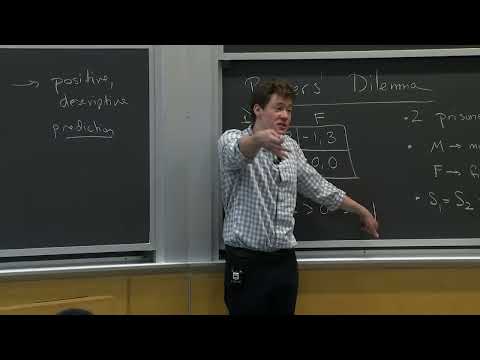
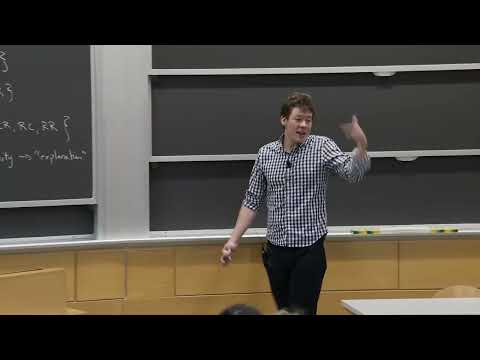
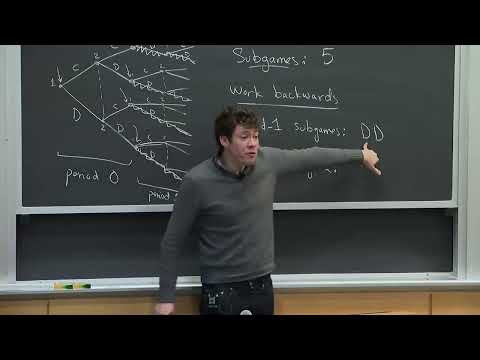
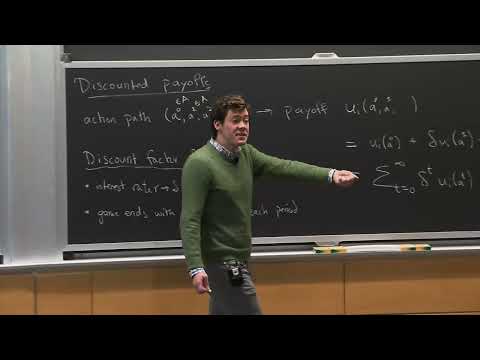
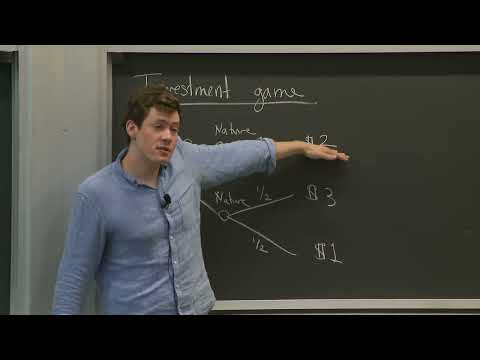
Ian Ball continues MIT's 14.12 Economic Applications of Game Theory with a session on multi-stage games. He introduces the one-shot deviation principle, the tool that lets economists check whether a strategy profile is a subgame perfect equilibrium by testing single deviations at each decision point rather than every possible alternative strategy. The lecture builds from the formal statement of the principle toward its application in bargaining models, showing how repeated offers and counteroffers can be analyzed stage by stage. Ball works through the underlying logic on the board, connecting the technique back to backward induction and extensive-form games covered earlier in the course. Runtime runs about 78 minutes, consistent with a full class session rather than a highlight reel, and the material assumes familiarity with basic game-theoretic notation from prior lectures in the sequence.
More from this course

12 LECTURES
Introduction to Individual Decision-Making

Introduction to Individual Decision-Making

MIT · 57 MIN
Representation of Games

Representation of Games

MIT · 73 MIN
Lecture 3: Dominance

Lecture 3: Dominance

MIT · 76 MIN
Lecture 4: Rationalizability

Lecture 4: Rationalizability

MIT · 82 MIN
Lecture 5: Nash Equilibrium

Lecture 5: Nash Equilibrium

MIT · 79 MIN
Imperfect Competition

Imperfect Competition

MIT · 81 MIN
Zero-Sum Games

Zero-Sum Games

MIT · 81 MIN
Lecture 8: Backward Induction

Lecture 8: Backward Induction

MIT · 77 MIN
Lecture 9: Negotiation

Lecture 9: Negotiation

MIT · 74 MIN
Lecture 10: Subgame-Perfect Nash Equilibrium

Lecture 10: Subgame-Perfect Nash Equilibrium

MIT · 81 MIN
Lecture 12: Finitely Repeated Games

Lecture 12: Finitely Repeated Games

MIT · 77 MIN
Lecture 13: Infinitely Repeated Games

Lecture 13: Infinitely Repeated Games

MIT · 82 MIN