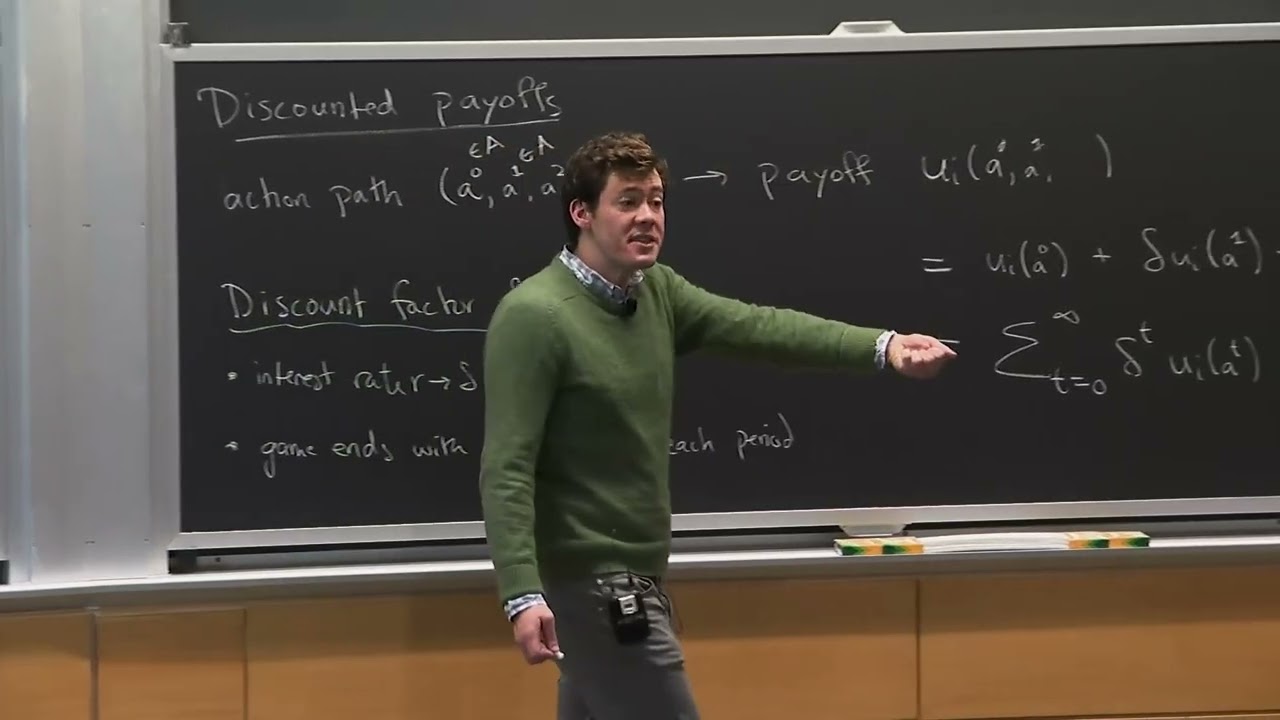
Lecture 13: Infinitely Repeated Games
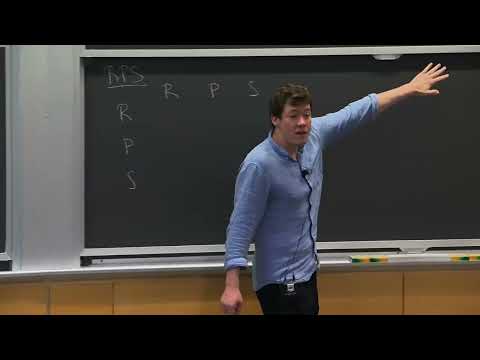
Ian Ball teaches this session of MIT's 14.12 Economic Applications of Game Theory, covering infinitely repeated games, where players face the same stage game over and over with no fixed end. Ball explains how the shadow of future interaction can sustain cooperation that would collapse in a one-shot game, working through the logic of grim trigger strategies and the folk theorem, which shows how a wide range of payoffs become achievable as equilibrium outcomes once discounting is factored in. The lecture builds on earlier sessions covering finite and static games, using formal notation and payoff matrices worked out on the board. Runtime is 82 minutes, pitched at students who already have a grounding in Nash equilibrium and backward induction. The core question addressed is what conditions on patience and monitoring make sustained cooperation a rational strategy rather than wishful thinking.