Lecture 16: Bayesian Games
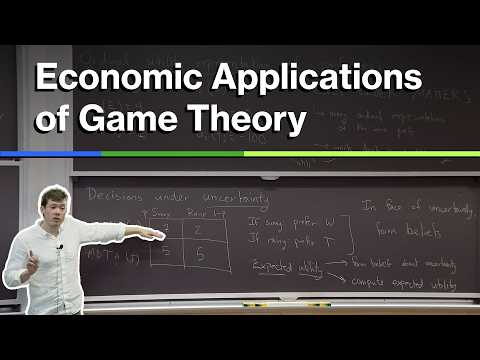
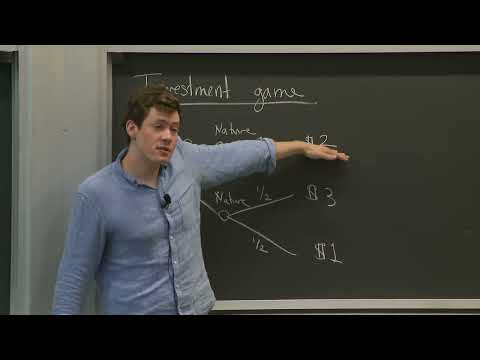
Ian Ball teaches this session of MIT's 14.12 Economic Applications of Game Theory, covering Bayesian games, the branch of game theory dealing with incomplete information. Ball works through how players form beliefs about other players' types, preferences, and payoffs when this information is not common knowledge, and how those beliefs feed into equilibrium strategies. The lecture builds on earlier sessions covering complete-information games, extending the framework with Harsanyi's approach of modeling incomplete information through a probability distribution over player types. Expect formal notation, worked examples, and discussion of Bayesian Nash equilibrium as the solution concept, delivered in the standard blackboard lecture format typical of MIT OpenCourseWare recordings. At 81 minutes, this is a full graduate-level treatment aimed at students already familiar with basic game-theoretic tools like dominant strategies and Nash equilibrium.