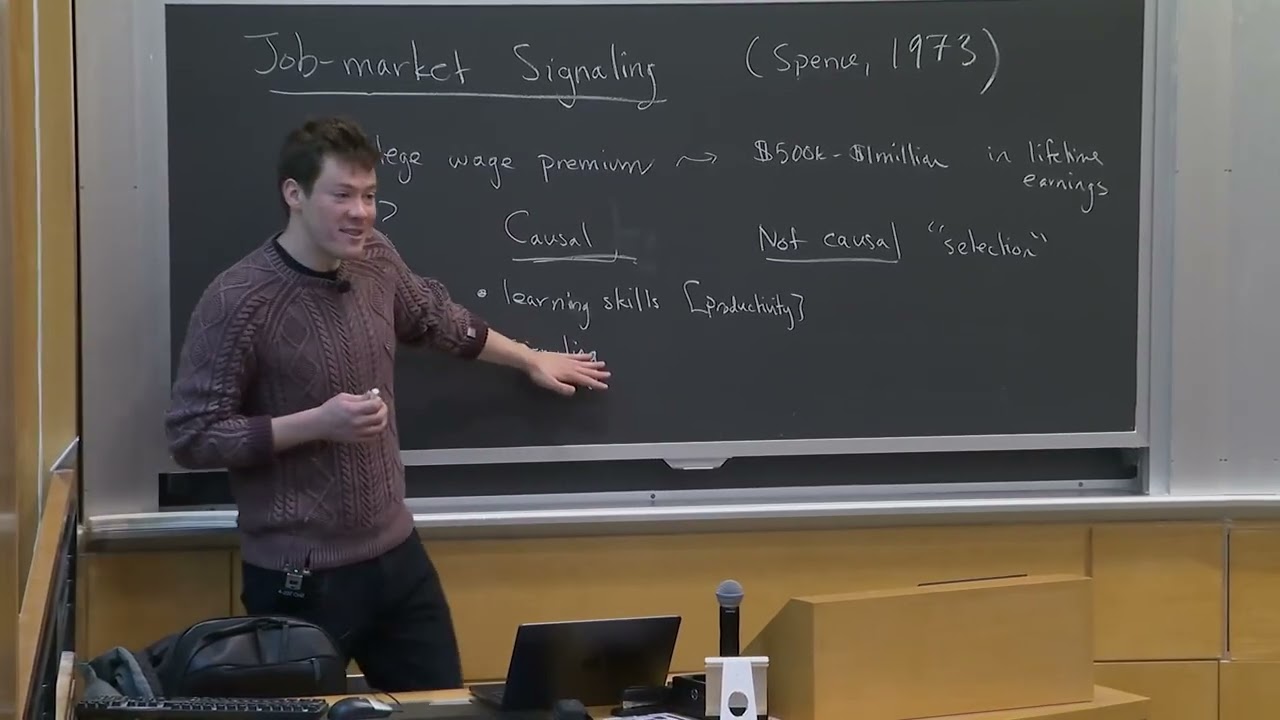
Lecture 22: Signaling
MIT's course 14.12, Economic Applications of Game Theory, continues with instructor Ian Ball working through a more complicated signaling model, a type of dynamic Bayesian game where one player's actions reveal private information to another. Building on earlier sessions, Ball develops the equilibrium concepts needed to analyze how an informed party can credibly convey information through costly actions, and how an uninformed party updates beliefs in response. The eighty-two minute session runs as a standard chalkboard-and-discussion lecture, with Ball walking through the formal setup, working through payoff structures, and deriving separating and pooling equilibria. It sits within a full-semester graduate sequence on game theory applications, assuming familiarity with prior lectures on Bayesian games. The lecture is aimed at students already comfortable with basic game-theoretic notation who want to see signaling theory extended to a more realistic, complex setting.