Acyl Insertions and Alpha-Reactivity
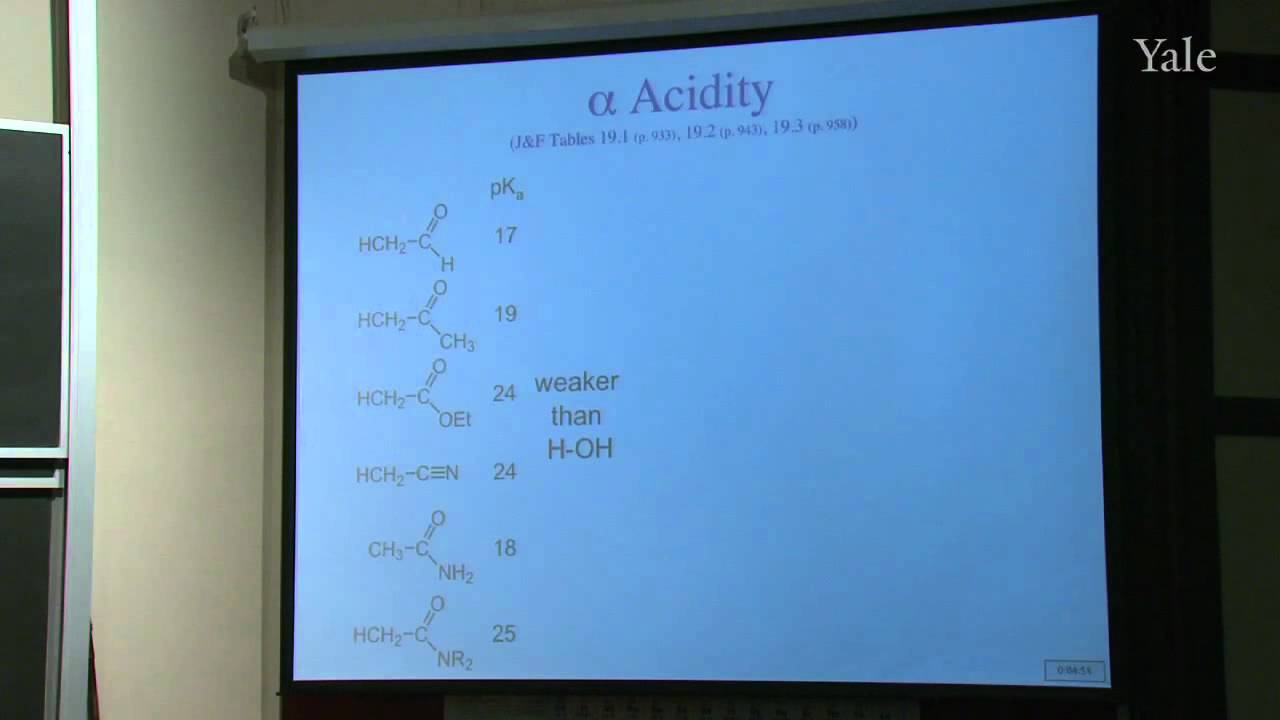
Michael McBride continues Yale's Freshman Organic Chemistry II with a lecture on acyl insertion reactions and alpha-carbon reactivity. He explains how a nucleophilic atom bearing a good leaving group can attack a carbonyl and trigger migration of an adjacent R group, inserting oxygen, nitrogen, or carbon into the acyl bond, with the Beckmann rearrangement of oximes as the stereochemical test case. McBride shows that migrating groups, though formally anionic, actually lose electron density during rearrangement based on migratory aptitude data. The lecture then turns to alpha-acidity, showing how enol and enolate formation gives alpha-carbons nucleophilic character under both acidic and basic conditions, accounting for H/D exchange, racemization, alpha-halogenation, and alpha-alkylation. Recorded in spring 2011 as lecture 35 of the course, it runs about 49 minutes with chapter markers for each mechanism discussed.